
How to Match Ceramic Brake Pads with Brake Discs: Materials, Design, and Performance Fit
Summary:
Ceramic pads need thermally stable, rotor-friendly discs and proper design fit to deliver quiet, consistent braking. Match compounds to disc metallurgy (high-carbon cast iron, stainless, or carbon-ceramic), confirm geometry and hardware, and manage heat with vane/slot design. Then bed the pair to build an even transfer layer. The result: lower noise and dust, longer life, and dependable stopping across city, highway, and mountain driving.
How to Match Ceramic Brake Pads with Brake Discs
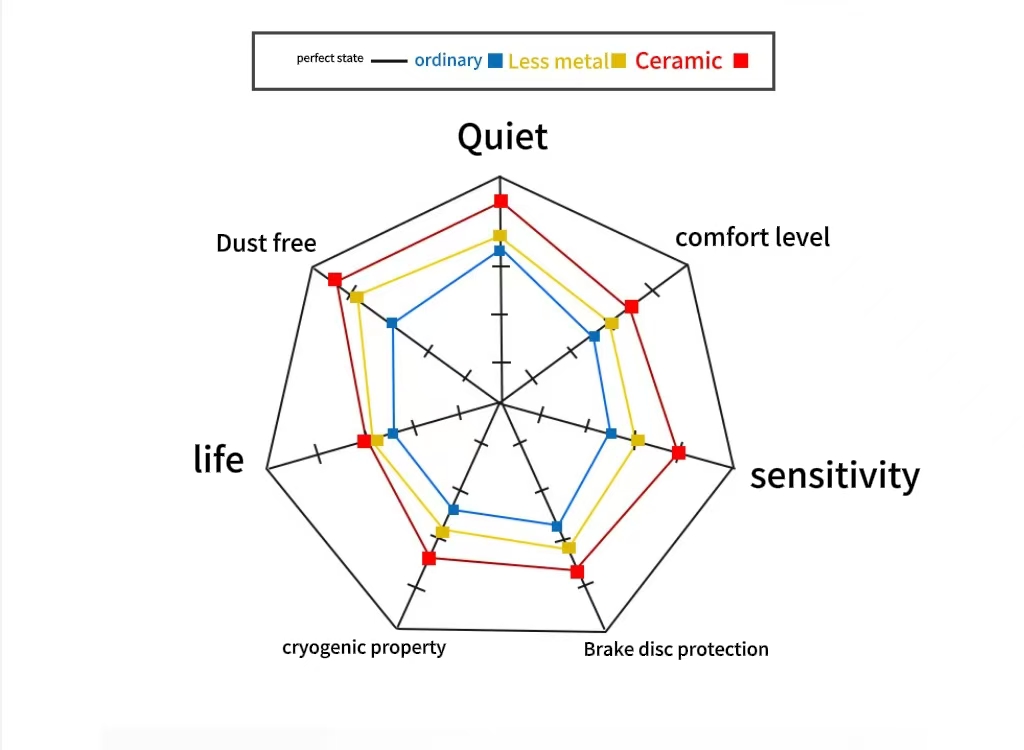
Getting ceramic pads to perform at their best depends on three pillars: material compatibility, design fit, and performance (duty-cycle) matching. Nail all three and you’ll get stable friction, low noise, and long service life—without chewing up rotors.
1) Material Compatibility (Pad ↔ Disc)
What ceramic pads are
Modern “ceramic” pads are advanced composites (mineral/aramid/ceramic fibers, engineered fillers, high-temp resin), tuned to form a stable transfer layer on the disc at operating temperature.
Disc options & what they mean
- High-carbon gray cast iron (HC cast iron / GG25+): Excellent thermal capacity and damping; pairs very well with ceramic pads for quiet, rotor-friendly braking.
- Standard cast iron: Acceptable, but more sensitive to heat spots; ensure proper bedding and cooling.
- Stainless/treated steels (some motorsport/MC applications): Harder surfaces; need pad compounds proven against higher hardness and different heat flow.
- Carbon-ceramic rotors (CCM/CCB): Require dedicated CCM-rated pads; do not mix standard ceramic pads with CCM unless explicitly approved.
Rules of thumb
- Pad must be hard enough to resist smear at temp, but not so abrasive that it scores the disc.
- Disc should offer good damping & thermal stability so the pad’s transfer layer remains even.
- If you change disc metallurgy (e.g., to drilled/slotted high-carbon rotors), re-evaluate pad choice and re-bed.
2) Design Fit (Geometry, Contact, Cooling)
- Exact geometry: Verify OE/WVA number, length/width/thickness, ear/clip shape, hole positions, chamfers and slots, and shim kit. Small geometry errors cause noise, taper wear, or drag.
- Surface finish & runout: Rotor finish (Ra) must be within spec; runout and DTV (thickness variation) should be minimal to prevent shake and pad imprint.
- Cooling architecture:
- Vented rotors with optimized vane design remove heat efficiently—ideal for ceramic pads.
- Drilled/slotted can help gas/debris evacuation but may raise wear/noise if materials are mismatched.
- Hardware health: Clean/lube slide pins and abutments; use quality anti-rattle clips and multi-layer shims designed for ceramic NVH behavior.
3) Performance Matching (Duty Cycle & Environment)
Match the pair to how the vehicle is used:
| Use case | Recommended disc | Ceramic pad notes |
|---|---|---|
| Daily city / highway | High-carbon vented cast iron | Prioritize quiet/low dust; stable μ at moderate temps |
| Mountain / towing / heavy loads | High-carbon vented, larger mass; slots optional | High-temp ceramic with strong fade resistance; strict bedding & cooling |
| Performance street | High-carbon vented; directional vanes; light slotting | Performance ceramic compound; monitor rotor heat spots |
| Track / extreme heat | Purpose-built iron or carbon-ceramic (OEM system) | Use track-rated pads; standard “ceramic street” is not suitable |
| EVs (regeneration + rare friction use) | High-carbon; corrosion-resistant coatings | Low-corrosion disc; ceramic pads with good cold bite to clear films |
Compatibility Matrix (Quick View)
| Disc type | With ceramic pads | Notes |
|---|---|---|
| High-carbon cast iron | ✅ Excellent | Quiet, stable, rotor-friendly |
| Standard cast iron | ✅ Good (with care) | Watch heat spots; bed carefully |
| Drilled/slotted cast iron | ✅ Conditional | Good gas/dust control; may raise wear/noise if mis-matched |
| Stainless/steel rotors | ⚠️ Conditional | Harder surface; confirm compound approval |
| Carbon-ceramic (CCM/CCB) | ❌ / Specialized | Use CCM-approved pads only |
Bedding: The Bridge Between Materials and Performance
Even with a perfect material/design match, you must bed the pair to create a uniform transfer layer:
- 8–10 medium decels (≈60→20 km/h) with cool-down airflow between stops.
- 3–4 firm decels (≈80→30 km/h), again with cool-down.
- Park to air-cool; avoid holding the pedal on hot rotors.
This reduces glazing and locks in stable μ, low NVH, and longer pad/rotor life.
Common Pitfalls (and Fixes)
- Noise after install → Check chamfers/slots, shims, hardware torque; finish or replace out-of-spec rotors; complete bedding.
- Early fade on descents → Upgrade to higher-temp ceramic or increase rotor mass/cooling; use engine braking.
- Rotor scoring → Pad too abrasive for that disc; switch to a rotor-friendly ceramic or change disc metallurgy/finish.
- Uneven wear/taper → Caliper slide or abutment issues; fix hardware and re-bed.
- Dust still too high → Choose a lower-abrasion ceramic tuned for your rotor and duty.
Pre-Purchase & Install Checklist
- Confirm OE/WVA and geometry match ✔
- Choose high-carbon vented rotors for most ceramic applications ✔
- Use complete shim/clip kit; lube slides with high-temp brake grease ✔
- Measure rotor runout/DTV; correct surface finish ✔
- Verify compound approval for drilled/slotted or non-iron rotors ✔
- Perform full bedding; avoid hard holds on hot rotors ✔
FAQs
Q1: Can I run ceramic pads on any cast-iron rotor?
Generally yes, but you’ll get the best results on high-carbon vented rotors with correct finish and low runout, plus proper bedding.
Q2: Are drilled/slotted rotors always better with ceramic pads?
Not always. They can improve gas/dust evacuation but may increase wear/noise if the compound and driving profile don’t require them.
Q3: Why is bedding still necessary with ceramic pads?
Bedding builds a uniform transfer layer, stabilizing friction and reducing noise and uneven wear—critical for pad–disc harmony.
Q4: Can I use standard ceramic pads on carbon-ceramic rotors?
No. Use CCM-approved pads only. Mixing unapproved compounds can damage the rotor and degrade braking.
Need help pairing ceramic pads with the right rotors for your duty cycle? Contact Baiyun Brake for compound matching, rotor recommendations, test data, MOQ, and lead time.
Was this article helpful?
Average Rating: 5/5 (8158)