
How to select the right brake lining replacement for semi-trucks – Commercial Carrier Journal
Summary:
How to select the right brake lining replacement for semi-trucks goes beyond just checking the part number. Fleet buyers and maintenance teams need to weigh friction material performance, ECE R90 certification, WVA fitment, and supplier reliability. This guide breaks down the practical steps to avoid counterfeit parts, match linings to duty cycles, and verify manufacturer certifications. Drawing on insights from the Commercial Carrier Journal and decades of heavy-duty manufacturing experience, you'll learn a systematic approach that reduces cost-per-mile and keeps your trucks compliant. Whether you're importing container loads or stocking a regional warehouse, the right selection process protects your bottom line and your drivers.
How to select the right brake lining replacement for semi-trucks - Commercial Carrier Journal
Quick answer: Selecting the right brake lining for a semi-truck boils down to matching friction material to your fleet's duty cycle, verifying ECE R90 certification, using the WVA reference for precise fit, and partnering with a supplier that holds IATF 16949. Skip any of these steps and you risk shortened lining life, unpredictable stopping distances, or a roadside inspection failure. Always demand physical test reports and batch-level traceability—there's no room for guessing when 80,000 lbs is on the line.
What’s driving the cost vs. quality debate in fleet brake linings?
A purchasing manager once told me he could source brake linings at half the cost of a name-brand set. He was right about the price. What he didn't count on was the premature cracking that showed up at 30,000 miles—and the three-hour roadside delay that followed. That single event erased any savings from the cheaper parts.
In the Air Brake Book series, SilverbackHD's Vice President of Operations Keith Roth put it bluntly: “You get what you pay for, so be careful who you choose as a partner parts supplier.” The same publication warns about counterfeit and “look-alike” will-fit parts that rarely meet OE performance requirements. A fleet investing in commercial vehicle brake linings that carry full certifications might pay more upfront, but the total cost per mile almost always ends up lower. It's the same story across the industry: linings that degrade faster cause more drum wear, higher labor costs, and unplanned downtime. If you're running a fleet of 50 tractors, a difference of 0.02 in friction coefficient consistency can show up as a measurable increase in brake service intervals.
This isn't just about performance. When a major carrier specifies a brake lining, the legal department reviews parts documentation as carefully as the maintenance team does. A lining without an ECE R90 test report creates liability exposure that no insurance adjuster will ignore. You want a bill of materials, not a box of surprises.
How do you match brake lining material to your truck’s duty cycle?
Ask ten fleet managers what they run and you'll get eleven answers. But underneath the preferences, the decision always traces back to the application. A truck hauling aggregates on hilly routes needs a different friction characteristic than a line-haul tractor cruising flat interstates. Most heavy-duty linings fall into two broad friction code families: FF and GG, as defined by SAE J866. An FF code offers moderate friction with stable torque, making it a solid choice for general freight operations. A GG code leans toward higher friction at elevated temperatures—useful for vocational trucks that see repeated braking from highway speeds.
But the code alone isn't enough. You need to dig into the manufacturer's dynamometer data. What's the friction coefficient at 200°C? How does it behave after thermal cycling to 400°C? These numbers directly affect pad and drum life, as well as stopping distance consistency. In our own testing at IATF 16949 certified facility, we've seen some formulations hold a 0.38–0.42 μ range across 100–350°C, while others drop sharply past 300°C. That drop represents a real-world risk—when descending a 6% grade, your lining temperatures can exceed 350°C within 30 seconds if the engine brake isn't engaged.
There's also the matter of bedding-in behavior. Some aftermarket linings require a specific burnish procedure to reach optimal performance, and if your technicians don't follow it, you'll get uneven transfer layers and noise complaints. A decent supplier will include clear bedding-in instructions and a brake lining installation guide that covers torque specs, drum condition checks, and initial mileage recommendations.
Why are certifications like ECE R90 and IATF 16949 non-negotiable?
A piece of paper doesn't stop a truck. But the testing behind that paper confirms your linings will perform when they're needed most. ECE R90 requires brake linings to maintain at least 80% of their cold effectiveness after thermal cycling to 400°C. The test also checks speed sensitivity and pad compressibility. If a batch fails, it can't be sold for on-road use in ECE-regulated markets.
IATF 16949 goes a step further. It's not just a product test—it's a manufacturing quality system certificate. It means the factory uses statistical process control, maintains full material traceability, and undergoes annual surveillance audits. For a distributor importing container loads of wholesale CV brake pads, that certificate is the difference between a recall-prevention process and a reactive one. When a European importer recently asked us for batch-specific test data, our production records traced every set of linings back to the specific mixing batch and pressing date. That's the level of transparency that a generic supplier without IATF 16949 simply can't match.
Don't assume every lining on the market meets these standards. I've seen shipping documents marked "ECE R90 approved" with no accompanying test report number. A legitimate supplier will provide the approval number and the test laboratory name. If they hesitate, walk away.
How to use the WVA reference system for exact fitment
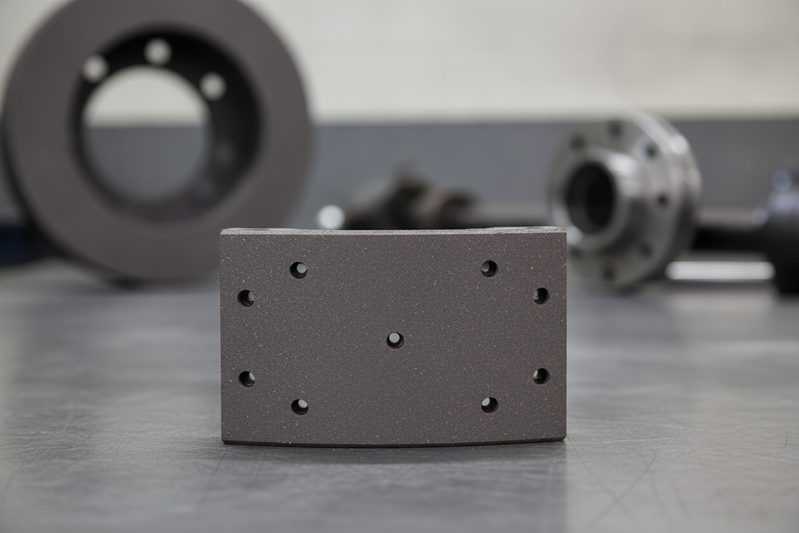
The WVA (World Vehicle Aftermarket) numbering system is the closest thing to a universal language for brake lining dimensions. Each reference number corresponds to a specific set of geometric data: arc length, width, thickness, rivet hole pattern, and chamfer profile. If you're working with a mixed fleet of Volvo, Scania, and Mercedes-Benz trucks, the WVA cross-reference prevents you from mistakenly ordering a lining that's 2 mm too narrow for the shoe table.
That said, a WVA number isn't a substitute for physical sample verification. We've seen instances where a lining carries the correct WVA code but the chamfer angle doesn't match the OEM specification, causing edge loading and noise. Always check the dimensions of a new part against the removed lining before bulk installation. When you're evaluating a new supplier, request a dimensional drawing with tolerances for each WVA reference you plan to stock. If the tolerances aren't documented, you're gambling.
For linings not in the public WVA catalogue—some OEM proprietary designs—only the vehicle manufacturer's part number or a physical sample can ensure compatibility. That's where a supplier's engineering support team becomes critical. You need someone who can reverse-calculate the required shoe radius and lining arc from your drum wear measurements. This isn't something you want to learn through trial and error on a loaded semi.
What should a fleet distributor look for in a brake lining supplier?
A supplier's brochure looks great until you need an urgent answer about lead time on a 400-set order. Here's what separates a reliable partner from a transactional vendor:
- Production capacity and lead times: Ask about monthly output for your specific WVA references. A manufacturer with multiple hot-press lines can typically deliver standard orders in 30–45 days, but custom formulations may require longer. Make sure their logistics team handles export documentation properly—you don't want a container held at customs because of incomplete packing lists.
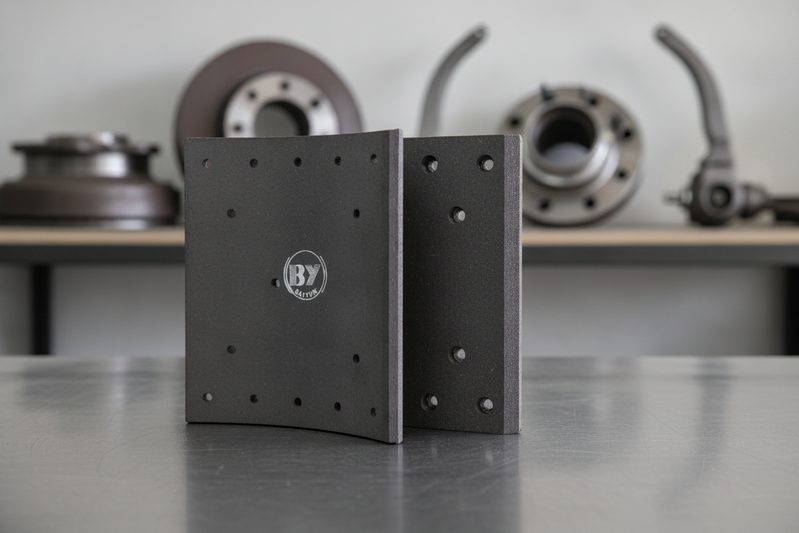
- Private labeling and OEM options: If you're building a house brand, the supplier should offer custom box branding, laser engraving on backing plates, and even formulation tuning. We regularly work with distributors who want their logo on the OEM brake lining solutions while relying on our R&D for material development.
- Technical support: When a fleet reports uneven wear, does the supplier send a field engineer or just an email? A trusted brake pad supplier will help diagnose the root cause—whether it's drum out-of-round, incorrect slack adjuster setting, or a lining mismatch.
- Consistency batch to batch: This is the quiet killer of fleet maintenance budgets. A friction coefficient that varies by ±0.03 between batches might seem minor, but across a 20-truck fleet, it leads to inconsistent pedal feel and some drivers reporting “soft brakes” while others don't. Insist on seeing statistical process control charts for at least the last 12 months.
Buyer verification checklist for semi-truck brake linings
Before you place an order, run through this checklist. It's saved more than one fleet from a costly mistake.
| Factor | What to Check | Why It Matters |
|---|---|---|
| ECE R90 Approval | Request the approval number and test laboratory name | Legal compliance for on-road use; ensures minimum performance standards |
| Friction Code (SAE J866) | Verify FF or GG code matches your duty cycle | Mismatched friction can cause overheating or poor cold performance |
| WVA Reference | Cross-check the WVA number with your removed linings and supplier dimensional drawing | Prevents fitment errors that cause drag or noise |
| Material Traceability | Ask for batch records linking lining to raw material lot | Essential for recall management and warranty claims |
| Manufacturing Certifications | Confirm IATF 16949 certificate is valid and audited | Indicates consistent process control and quality management |
| Lead Time & MOQ | Clarify production lead time and minimum order quantity | Avoids inventory shortages during peak seasons |
Common misconceptions about brake lining selection
Misconception: “A higher friction coefficient is always better.”
Reality: Excessively high friction can cause aggressive drum wear and thermal shock. The optimal μ is one that gives stable output across your fleet's temperature range without sacrificing drum life. In heavy trucks, exceeding a μ of 0.45 often leads to cracking issues in cast drums.
Misconception: “All brake linings with the same WVA number perform identically.”
Reality: The WVA number only covers geometric fit. Friction material formulation, compressibility, and shear strength vary significantly between manufacturers. Two linings with WVA 19999 could have entirely different wear rates and thermal fade characteristics.
Misconception: “OEM linings are always superior to aftermarket replacements.”
Reality: Many OEM linings are designed to meet minimum specification at a competitive price point—it's a cost-constrained engineering decision. A quality aftermarket supplier investing in higher-grade raw materials can sometimes deliver longer service life and better fade resistance. The key is verifying the data, not the box label.
FAQ: Brake lining selection for semi-trucks
Q: How do I know when a brake lining is worn enough to replace?
A: Any remaining lining thickness below 6.4 mm (1/4 inch) calls for immediate replacement. However, many fleets schedule relines when thickness falls to 8–10 mm to avoid drum damage from rivet contact. Regular visual inspection at each PM interval is your best defense against sudden failure.
Q: Can I mix brake linings from different suppliers on the same axle?
A: Don't do it. Differing friction characteristics will cause brake pull and uneven wear. If you must switch suppliers, replace both sides of the axle as a set and reburnish the new linings per the manufacturer's procedure. This prevents a steering pull that can surprise a driver in a panic stop.
Q: What's a realistic shelf life for brake linings in storage?
A: Most linings remain stable for 5–7 years if stored in a dry, temperature-controlled environment. Once installed, calendar age matters less than usage cycles. However, linings exposed to moisture or extreme heat in storage can develop surface glazing that affects initial bite—inspect stored inventory before installation.
Q: Does ECE R90 certification guarantee compatibility with American brake systems?
A: ECE R90 is a performance standard, not a dimensional specification. While the test requirements are similar to FMVSS 121, the fitment still depends on WVA matching and OEM design. Always verify geometry independently, especially when importing linings for North American trucks.
Q: How can I reduce brake noise complaints from drivers?
A: Noise often stems from glazed linings, improper bedding, or drum out-of-round. Start by checking drum runout and cleaning the shoe table thoroughly. Use a lining with a chamfer design that reduces leading-edge impact, and ensure your techs follow the bed-in process. If noise persists, the lining material itself may be incompatible with the drum metallurgy—something a supplier with strong R&D can help diagnose.
Making the right call for your fleet
Selecting brake linings isn't a one-and-done event. It's a process that ties together your fleet's operating profile, your maintenance team's skill, and your supplier's engineering depth. The cheapest lining on the market might save you money on the invoice but cost you in roadside downtime, driver confidence, and CSA scores.
We've shipped brake linings to over 60 countries, and the fleets that see the lowest cost-per-mile are the ones that treat brake parts as an engineered system—not a commodity. That's why we make our test data, WVA cross-references, and batch records available before you ever see a pallet. If you're evaluating a new source for commercial vehicle brake linings, start with a trial order of a few axle sets and monitor wear patterns closely. Ask for the documentation we discussed, and if the supplier can't produce it, keep looking.
Ready to upgrade your fleet's brake performance? Get in touch with our export team to discuss WVA requirements, volume pricing, and private label options. Let's make sure your trucks stop as predictably as your business depends on.
Was this article helpful?
Average Rating: 5/5 (329)