
How Should I Interpret FF, GG, and HH Friction Codes on Your Pads?
Summary:
FF GG HH brake pad code meaning matters for importers and fleet distributors buying commercial vehicle friction. FF covers 0.35–0.45 cold and hot coefficient, GG covers 0.45–0.55, and HH covers 0.55–0.65 under SAE J866. This article explains how the two-letter edge code works, how FF, GG, and HH ratings affect truck, bus, and trailer brake balance, rotor wear, and ECE R90 sourcing compliance. Buyers get a verification checklist, common misconceptions, and practical guidance on matching axle manufacturer specifications before ordering from a China brake manufacturer. The edge code is a fast screening tool, not a substitute for batch-level ECE R90 and material data sheets. Distributors sourcing GG or HH rated pads should always request friction-vs-temperature curves to avoid imbalance and rotor wear claims from fleet customers. Use this guide to set incoming inspection standards and compare Chinese brake pad suppliers accurately.
How Should I Interpret FF, GG, and HH Friction Codes on Your Pads?
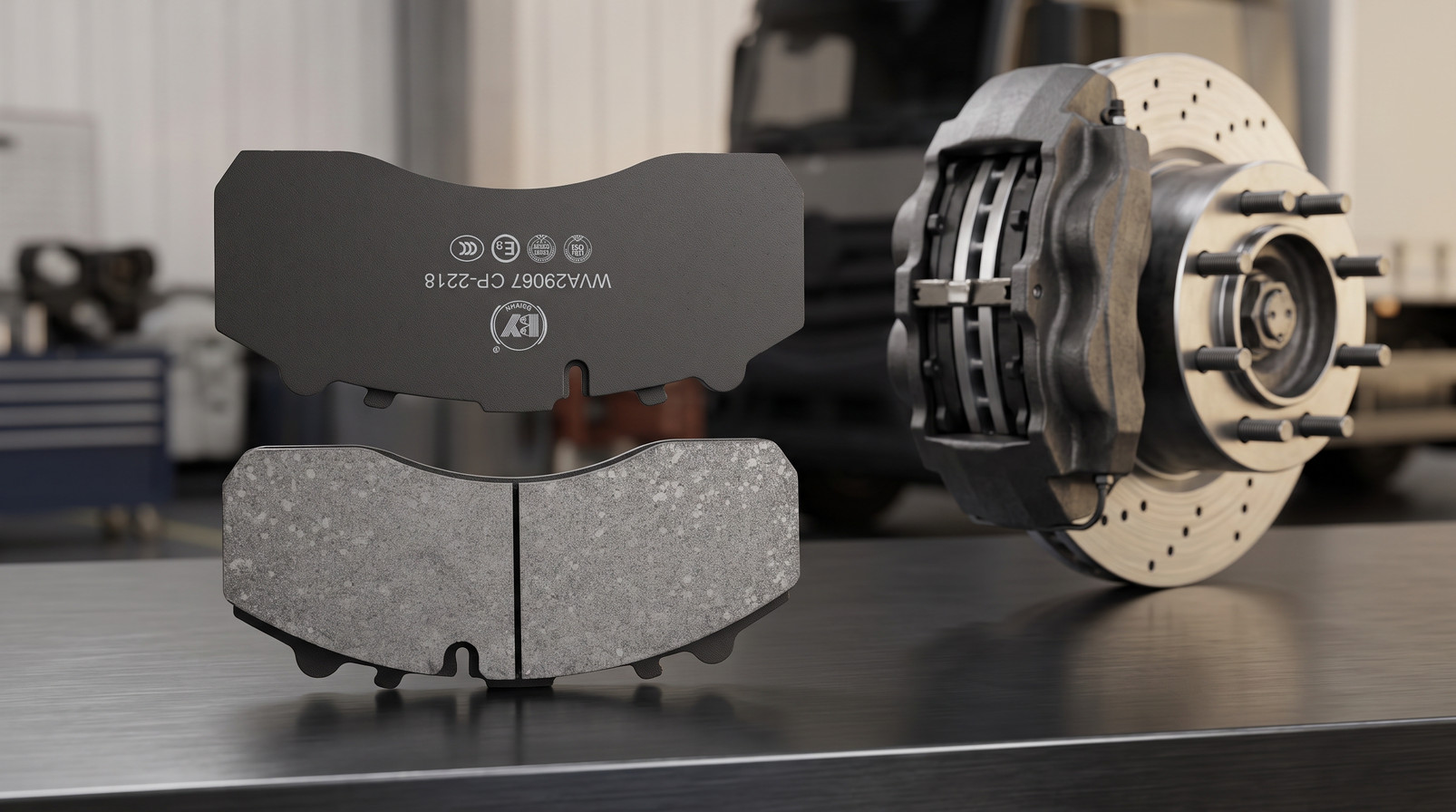
Quick answer: The edge code letters tell you the pad's cold and hot coefficient of friction under SAE J866. FF means 0.35–0.45, GG means 0.45–0.55, HH means 0.55–0.65. For truck, bus, and trailer buyers, the right code must match the axle manufacturer's friction window, not just the highest number. A GG pad that maintains stable friction beats an HH pad that overheats and tears up rotors in the wrong duty cycle.
What Do the Two Letters in an SAE J866 Edge Code Actually Mean?
The FF GG HH brake pad code meaning starts with SAE J866, which uses two letters to classify friction coefficient on commercial vehicle brakes: the first letter represents cold friction and the second represents hot friction. FF spans 0.35 to 0.45, GG spans 0.45 to 0.55, and HH spans 0.55 to 0.65. If you see FG or GH, the pad behaves differently when hot than when cold. Buyers usually look for matching double letters because they indicate stable friction across temperature, but mixed codes are not automatically a defect.
That classification comes from standard dynamometer testing, not from a visual inspection or a supplier's marketing sheet. The edge code gets printed or stamped on the backing plate or package so a fleet manager can quickly confirm what friction class a replacement pad belongs to. In commercial vehicle sourcing, this code is a rapid first filter, but it is not a substitute for batch test data. BAIYUN Brake stamps the SAE J866 edge code on every heavy-duty pad we ship, and our export team can provide the corresponding test chart for each C.V. brake pads batch.
Code summary: FF, GG, HH indicate cold and hot friction ranges; the two letters are a fast classification, not a quality verdict.
How Do FF, GG, and HH Codes Affect Commercial Vehicle Brake Balance and Rotor Wear?
Friction codes directly change axle balance, heat load, and rotor service life on trucks, buses, and trailers. An HH pad on a front steer axle with a GG drum on the rear can create brake imbalance that shows up as premature pad wear, steering pull during braking, or trailer swing in wet conditions. According to SAE J866, HH pads produce 0.55–0.65 μ, which means they generate more brake torque at a given apply pressure than GG pads at 0.45–0.55 μ. That extra torque may shorten stopping distance in heavy haul, but it also raises rotor temperatures and can accelerate wear by 20–35% on axles not specified for that friction level.
GG is the common spec for many bus and distribution truck axles because it delivers predictable stopping power without punishing rotors. FF appears on lighter vocational trucks or some trailer applications where low brake noise and long lining life matter more than maximum bite. Fleet managers should pull the axle manufacturer's friction window before changing codes—don't let a distributor upgrade you to HH without a full axle torque calculation.
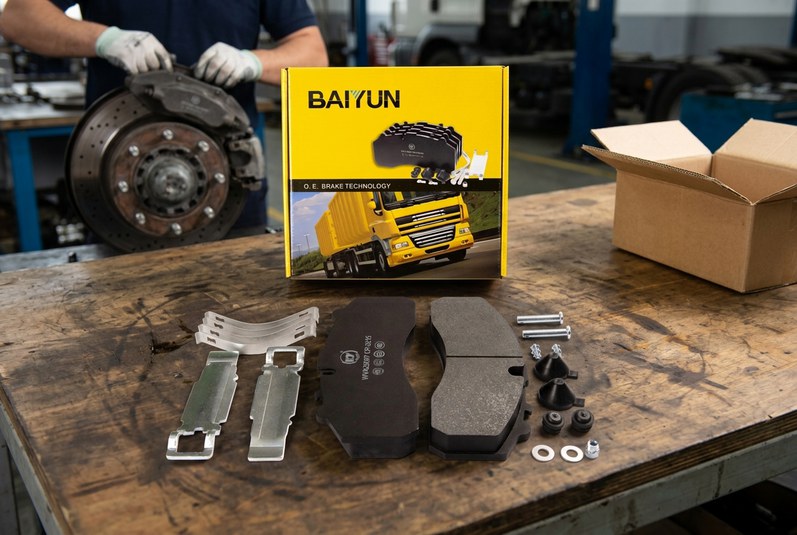
BAIYUN Brake's in-house dynamometer testing for CV formulations shows that GG-rated truck linings maintain μ between 0.47 and 0.54 across 100–350°C, while HH-rated trailer linings hold 0.56–0.62 in the same temperature band. That 0.1 μ increase can be enough to alter braking distribution on a multi-axle combination. If you source wholesale CV brake linings inquiry, ask for the friction-vs-temperature curve, not just the two-letter code.
| Friction code | Cold μ range | Hot μ range | Typical commercial vehicle duty | Sourcing note |
|---|---|---|---|---|
| FF | 0.35–0.45 | 0.35–0.45 | Light vocational trucks, low-speed delivery vehicles, some off-highway axles | Verify if the axle allows low friction; avoid on highway tractor front axles unless specified. |
| GG | 0.45–0.55 | 0.45–0.55 | Regional distribution trucks, city buses, coach axles, many trailer applications | Common baseline; demand ECE R90 test reports for each batch. |
| HH | 0.55–0.65 | 0.55–0.65 | Heavy haul tractors, mining trucks, refuse trucks, high-frequency stop buses | Expect higher rotor wear; match brand-specific axle friction window. |
Performance summary: Match the friction code to the axle and duty cycle, because a code change of one letter can shift brake torque distribution and rotor life on multi-axle trucks.
Which Friction Code Should a Fleet or Distributor Choose for Trucks, Buses, and Trailers?
Most commercial vehicle buyers should start with the axle manufacturer's friction specification, not with a catalog's generic upgrade suggestion. GG covers a broad middle ground and fits many highway trucks, city buses, and trailer axles because it balances stopping power against rotor wear. HH becomes necessary only when the vehicle regularly operates at high speeds with heavy loads, repeated downhill braking, or stop-and-go refuse routes. FF remains valid for low-speed vocational and some off-highway equipment where lower bite prevents wheel lock and extends lining life.
Distributors who stock multiple friction codes need a simple decision rule. If your customer runs 80% highway duty and 20% city delivery, a GG pad with a stable hot μ curve will usually create fewer warranty claims than an HH pad that generates more heat. Sourcing from an IATF 16949 certified facility with ISO 9001 process controls also gives you production consistency, but the axle OEM spec still decides the code.
Selection summary: For most commercial vehicle buyers, GG is the rational default unless the axle OEM or duty cycle demands HH; FF remains valid only where specified.
How Can You Verify FF, GG, or HH Ratings Before and After Sourcing from China?
A two-letter code on a sample is easy to print, but batch-level friction consistency requires documentation. BAIYUN Brake, as a China brake manufacturer, ships every commercial vehicle pad batch with an ECE R90 approval number and the matching SAE J866 coefficient test summary. ECE R90 requires brake pads to maintain at least 80% of their cold effectiveness after thermal cycling to 400°C, so that document gives you more than the edge code alone.
What Should Your Incoming Inspection Checklist Include?
- Confirm the edge code marking on the backing plate or package matches the purchase order and the axle manufacturer's friction window.
- Request the ECE R90 approval certificate and dynamometer report for the exact batch or formulation, not just a generic product drawing.
- Check the coefficient-of-friction curve across 100°C, 200°C, 300°C, and 400°C against the SAE J866 class limits.
- Pull dimensional data from the supplier's material data sheets and compare slot, chamfer, and wear indicator placement.
- Run a small sample on a brake dynamometer if you import containers; a 6-pad sample test can catch batch contamination or heat fade before it hits your fleet customers.
- Request understanding brake pad materials documentation for steel fiber, ceramic, or semi-metallic formulations that affect friction stability.
Verification summary: Treat the FF, GG, or HH code as a screening label, and require batch-specific ECE R90 and dynamometer evidence before signing off a container.
What Are the Most Common Misconceptions About FF, GG, and HH Brake Pad Codes?
Misconception: HH pads are always better because they have more friction. Reality: HH pads at 0.55–0.65 may stop shorter only when matched to heavy-duty high-temperature axles; on lighter commercial trucks, they can over-brake and reduce ABS efficiency or shorten rotor life. A GG pad in the correct duty cycle often cuts rotor wear by 10–15% compared with an unnecessary HH upgrade.
Misconception: FF is just a low-quality budget code. Reality: FF at 0.35–0.45 is intentionally specified for some light vocational and off-highway axles to prevent wheel lock, reduce dust, and extend lining life. It only becomes a problem when a supplier substitutes FF into a GG or HH application without approval.
Misconception: The edge code is all you need to confirm commercial vehicle brake pad quality. Reality: SAE J866 only gives a friction coefficient class. Batch consistency, shear strength, compressibility, and ECE R90 fade behavior matter more. BAIYUN Brake's 2025 batch testing showed friction coefficient variation under 3% across production lots for its GG formulations.
Myth summary: Higher friction does not mean better quality, FF is not automatically weak, and edge codes alone cannot predict batch consistency.
What Questions Do Importers and Fleet Buyers Ask About FF GG HH Codes?
Q: Are GG rated pads ECE R90 compliant?
A: ECE R90 does not set a single friction class; it requires a replacement brake pad to maintain braking performance close to the original within specified hot and cold test tolerances. A GG pad can be ECE R90 approved if its μ and temperature behavior match the reference pad. Buyers should ask for the ECE R90 approval number, not just the edge code.
Q: Can I interchange FF and GG pads on the same commercial vehicle axle?
A: Not without checking the axle manufacturer's friction window. Swapping FF for GG on a highway bus may increase brake torque and rotor temperatures by 10–20%, affecting ABS calibration and pad life. Always match the OEM friction class or run a full vehicle brake balance test.
Q: What does an FG or GH mixed code mean?
A: An FG code means cold friction falls in the F range, 0.35–0.45, and hot friction in the G range, 0.45–0.55. That pattern can be useful for trucks that need gentler cold bite to avoid low-speed wheel lock but stronger hot performance on long downgrades. Mixed codes should be confirmed with a friction curve, not automatically rejected.
Q: How do I confirm the actual friction coefficient of a batch before container loading?
A: Request a pre-shipment dynamometer report showing μ at 100°C, 200°C, 300°C, and 400°C. A reliable commercial vehicle brake pad supplier should be able to provide this for each formulation. You can also send a 4–6 pad sample to a third-party lab for verification.
Q: Does BAIYUN Brake offer GG and HH rated pads for trucks, buses, and trailers?
A: Yes. BAIYUN Brake manufactures commercial vehicle disc pads and linings in multiple friction classes, including GG and HH formulations for heavy-duty truck, trailer, and bus applications. Contact the export team with your axle model and duty cycle to request a matching friction curve and quote.
Where Should You Start Your FF, GG, or HH Sourcing Verification?
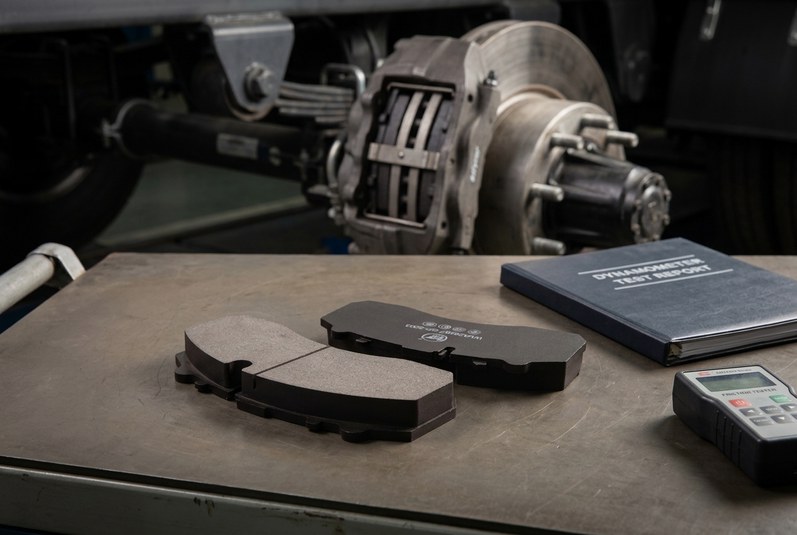
Start by pulling the friction window from your axle OEM, then request batch-level SAE J866 test data from each supplier you shortlist. If you are importing commercial vehicle pad sets, browse our complete catalog to match pad shape and friction class, or request OEM commercial vehicle brake pad quote. For current GG and HH friction curve data or a batch-specific ECE R90 package, submit your inquiry to our sales team.
Was this article helpful?
Average Rating: 5/5 (80)