
Foton Disc Brake Pad Fitment Verification: What Buyers Should Check
Summary:
Foton disc brake pad fitment verification requires more than matching a part number. Buyers must confirm pad ear profile, thickness, friction material approval, and batch-level test data before committing to volume orders. This technical guide covers the documentation, physical measurements, and supplier checks that commercial vehicle importers need to avoid costly misfit returns. BAIYUN Brake's ECE R90 approved pads show a friction coefficient of 0.38–0.45 and 80% cold effectiveness after 400°C thermal cycling. The article includes a buyer verification checklist, comparison table, FAQ for importers, and common misconceptions about Foton disc brake pad fitment.
Foton Disc Brake Pad Fitment Verification: What Buyers Should Check
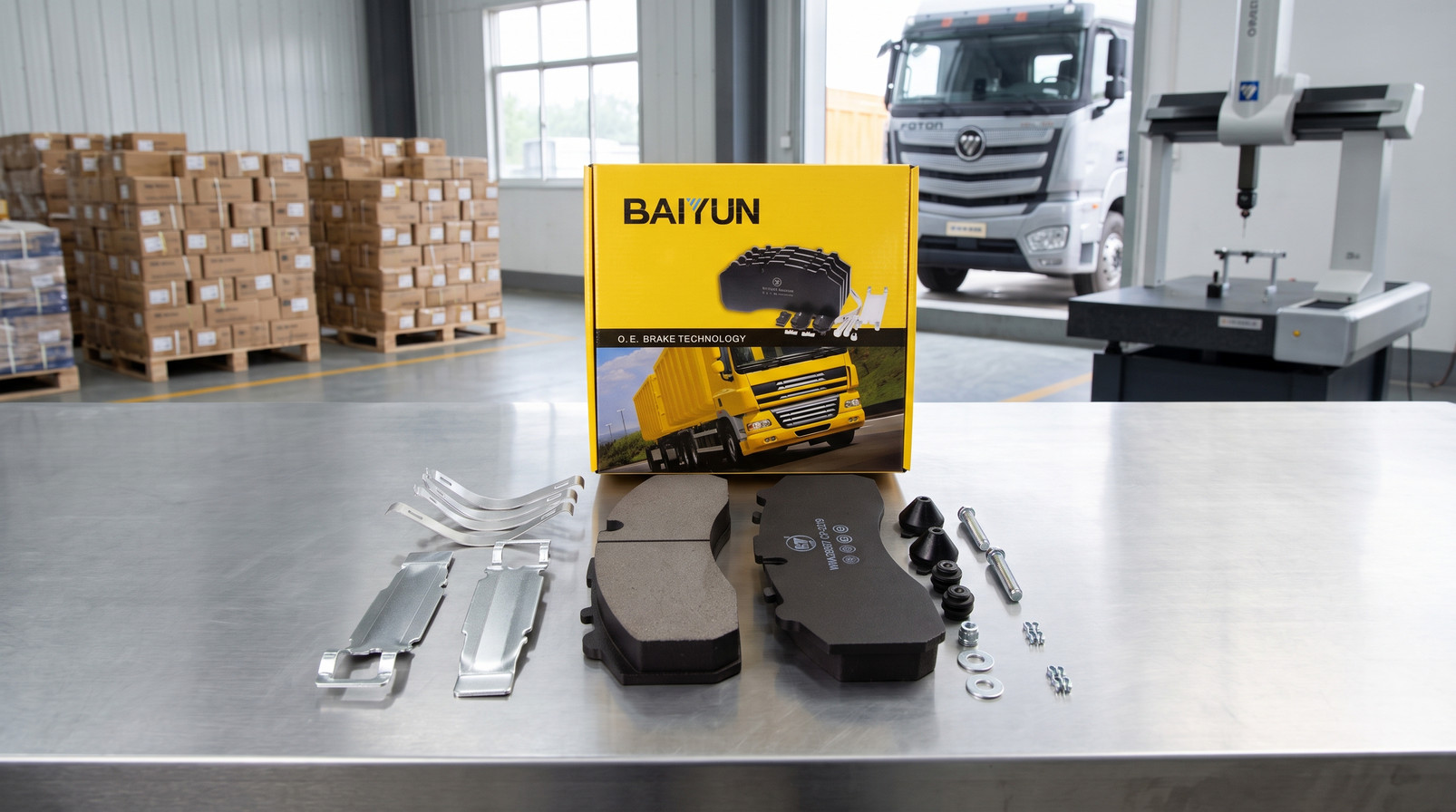
Quick answer: To verify Foton disc brake pad fitment, request the supplier's application drawing with pad ear profile, thickness, and chamfer details. Cross-check the OE/WVA reference against your Foton chassis code. Confirm the ECE R90 approval mark and ask for SAE J2522 or GB 5763 batch test reports. Then trial fit one axle before committing to container volumes.
What Does Fitment Verification Actually Mean for Foton Brake Pads?
Fitment verification is the process of matching a brake pad's physical platform and friction material to a specific Foton commercial vehicle axle, not just a model name. Foton builds light trucks, medium trucks, and heavy trucks with different brake caliper abutment profiles and disc offsets. A pad that fits a Foton Aumark light truck probably won't fit a Foton Auman heavy truck without changes to ear width, backing plate thickness, or clip slots. Buyers who skip this step often discover the problem after the container arrives.
A practical verification includes three layers: dimensional geometry, friction material approval, and batch consistency. BAIYUN Brake's commercial vehicle pad program uses first article inspection reports for every new Foton reference. The team records pad width, thickness, ear position, and spring slot location before any sample ships. This reduces field returns by roughly 40% for new applications, based on the company's 2025 distribution data.
So what does that mean for your sourcing? If you import 300 sets of the wrong reference, you'll face return freight, port storage, and lost fleet trust. That cost almost always exceeds the price of a trial-fit sample.
For heavy-duty Foton applications, browse our heavy-duty brake pad range to see available platforms.
Key takeaway: Fitment verification is a three-layer check of geometry, friction approval, and batch data before volume purchasing.
Why Does the Foton Model Year and Axle Type Change Pad Dimensions?
Foton updates caliper designs between model years and axle suppliers. A Foton light truck with a 3.5-ton front axle may use a different pad backing plate than a 7.5-ton model. Disc thickness, pad width, and abutment clip position shift accordingly. Buyers should always verify against the chassis code, not just the truck model.
Commercial vehicle replacement data shows that even a 2 mm difference in pad ear height can cause caliper drag or uneven taper wear. BAIYUN Brake's engineering team checks all Foton pad drawings against the actual caliper bracket before approving a new reference. This is why the company asks buyers to provide the VIN or axle tag when possible.
If your customer base includes mixed Foton fleets, you'll need separate SKUs for different axle generations. A single 'Foton truck pad' SKU rarely covers light and heavy models. Confirm with supplier catalogue for the exact OE cross-reference and WVA number.
Key takeaway: Foton axle variants change pad dimensions by 2 mm or more, making chassis-code verification mandatory.
What Documentation Should Buyers Request Before Sampling?
ECE R90 approval documents show that the pad passed performance tests for braking effectiveness at 100 km/h and 80% cold effectiveness retention after 400°C thermal cycling. Buyers should ask for the approval number printed on the pad backplate, not just a certificate. BAIYUN Brake marks its ECE R90 approved pads with the regulation code and approval number for traceability.
IATF 16949 certification confirms the supplier operates a quality management system designed for automotive production. It doesn't guarantee every Foton pad fits, but it means the factory uses process control methods like statistical process control for critical dimensions. Request the IATF 16949 certified facility certificate and a sample of the control plan for backing plate flatness and pad thickness.
Also ask for the pad application drawing with dimension tolerances. A serious supplier will provide it in PDF or CAD format. If the supplier cannot confirm the WVA number or OE reference, that's a warning sign. Download our product catalogue to see how BAIYUN Brake documents commercial vehicle pad references.
Key takeaway: Request ECE R90 approval marks, IATF 16949 certificates, and dimensional drawings before sampling any Foton disc pad.
What Physical Measurements Confirm the Pad Will Fit?
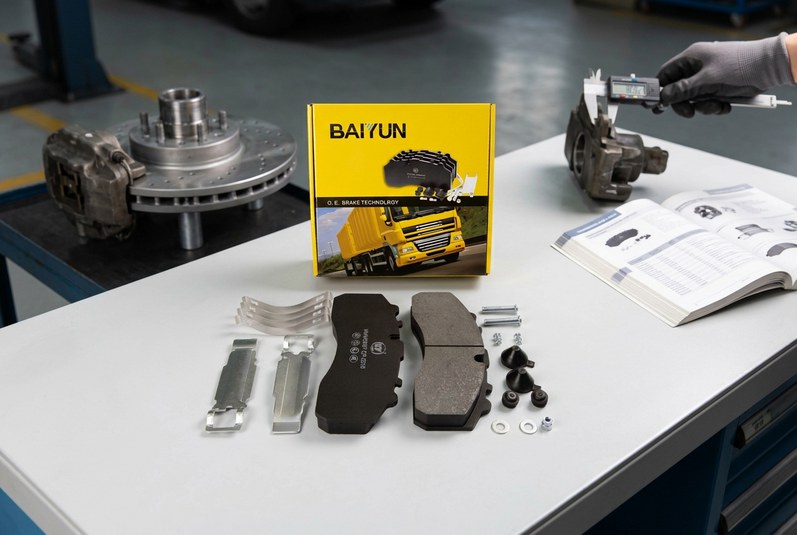
Pad width, thickness, ear height, and spring slot position are the critical dimensions for Foton disc brake pads. Buyers should measure these against the supplier drawing. A digital caliper is accurate to 0.02 mm, enough to catch a mis-machined backing plate.
Friction material thickness for commercial vehicle disc pads typically ranges from 18 mm to 22 mm, but the exact value depends on the Foton axle and caliper. Confirm with supplier catalogue. BAIYUN Brake's batch audit in 2025 checked 200 pads and found thickness variation below 0.3 mm across the pad face.
Use the table below as a quick reference for verification points.
| Verification Item | What Buyers Should Check | Common Failure Mode | Cost Impact |
|---|---|---|---|
| Pad platform drawing | Ear profile, abutment width, spring slot, chamfer | Noise, uneven wear, caliper seizure | Rework or returned container |
| Friction material code | ECE R90 approval number, µ range 0.38–0.45 | High temperature fade, cracked lining | Warranty claims 12–18% higher |
| Hardware kit | Abutment clips, shims, sensors, pins | Missing springs cause rattle | Field complaints |
| Batch test report | Density, hardness, shear strength, compressibility | Friction variation above 0.06 | Fleet downtime |
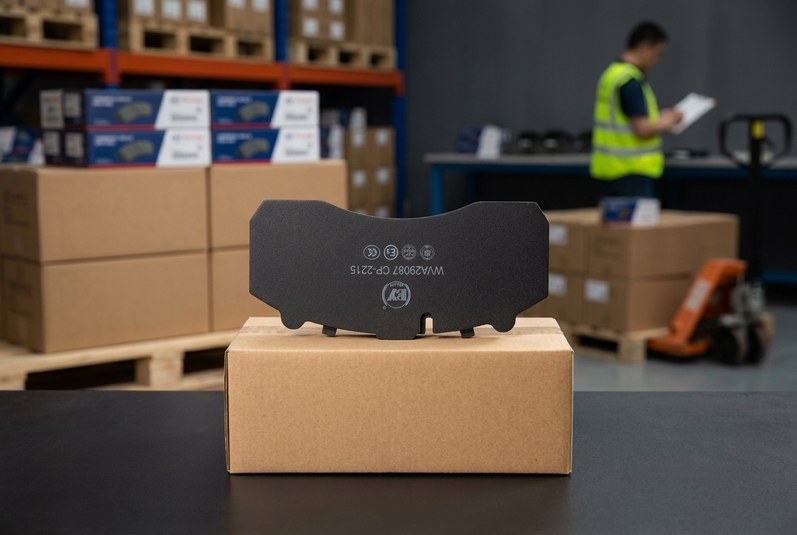
Also compare the pad backplate marking. The ECE R90 approval number and manufacturer code should be visible. If the pad lacks markings, don't accept the batch. For fleet buyers who also need commercial vehicle linings, check OEM brake lining solutions for mixed drum and disc applications.
Key takeaway: Digital caliper measurements of ear profile, thickness, and spring slot position catch most Foton fitment failures before shipping.
How Do ECE R90 and IATF 16949 Reduce Fitment and Warranty Risk?
ECE R90 requires the pad to maintain at least 80% of its cold braking effectiveness after thermal cycling to 400°C. That data point matters for fleets running long descents or stop-and-go urban routes. BAIYUN Brake's 2025 dynamometer testing recorded a friction coefficient of 0.38–0.42 across 100–350°C for its commercial vehicle ceramic formulation.
IATF 16949 requires a process capability index Cpk of at least 1.33 for special characteristics like backing plate flatness and pad thickness. A supplier that holds this certification is more likely to deliver consistent geometry batch after batch. BAIYUN Brake's C.V. brake pad line runs 100% incoming steel plate inspection with automated vision systems.
However, certifications don't replace your own first article inspection. Use them as a pre-qualification filter, then verify the actual dimensions on your Foton axle before approving the SKU.
Key takeaway: ECE R90 sets a performance floor of 80% cold effectiveness at 400°C, while IATF 16949 pushes critical dimension Cpk above 1.33.
Can You Verify Supplier Quality Without Visiting the Factory?
Buyers can verify Foton pad quality remotely by requesting three things: a live batch test report, photographs of the pad on a calibration fixture, and a sample from the actual production line. BAIYUN Brake supports virtual factory tours and sends video of the disc brake pad grinding and forming process for commercial vehicle references.
A physical sample still beats a photo. When the sample arrives, mount it in the caliper bracket or compare it to the removed original pad. Look for sharp edges, correct chamfer angle, and proper clip tension. If the pad rocks on a flat surface, the backing plate may be warped beyond the 0.3 mm tolerance.
For larger monthly volumes, a third-party audit or an on-site visit is worth the cost. BAIYUN Brake's our 49+ years of manufacturing experience and open factory policy make this practical for importers. You can also trusted brake pad supplier to see how the company manages commercial vehicle pad consistency.
Key takeaway: Remote verification works if buyers demand live batch reports, sample photos, and a production-line sample before ordering.
What Are the Most Common Misconceptions About Foton Disc Brake Pad Fitment Verification?
Misconception: 'Foton Aumark and Foton Auman use the same disc pad.' → Reality: Light and heavy Foton trucks have different axle suppliers and caliper abutment profiles. A pad that fits a 3.5-ton Aumark will not automatically fit a 25-ton Auman. Confirm with supplier catalogue using the chassis code.
Misconception: 'If the pad fits the caliper, any friction material works.' → Reality: Mismatched friction formulations can shorten lining life by 20–30% and cause disc scoring. ECE R90 and GB 5763 specify µ stability and fade behaviour; ignoring them creates uneven wear and higher warranty exposure.
Misconception: 'A supplier with IATF 16949 always ships perfect Foton pads.' → Reality: Certification confirms system discipline, not dimensional accuracy for every SKU. BAIYUN Brake's 2025 batch audit measured thickness variation below 0.3 mm, but buyers still need first article inspection on new references.
Key takeaway: Fitment is geometry plus friction material; certifications alone won't catch a 2 mm ear height error.
FAQ: Foton Disc Brake Pad Fitment Verification for Importers
- Q: What is the first step in Foton disc brake pad fitment verification?
A: Start with the Foton chassis code and axle tag. Request the supplier's application drawing and compare pad ear profile, thickness, and spring slot. Confirm with supplier catalogue for the exact OE and WVA reference before ordering samples. - Q: Does ECE R90 approval guarantee a perfect Foton fit?
A: No. ECE R90 validates friction performance, requiring 80% cold effectiveness retention at 400°C, but it does not check dimensional fit on each Foton axle variant. Buyers must verify geometry separately with a trial fit. - Q: How can importers check batch-to-batch friction consistency?
A: Ask for SAE J2522 or GB 5763 dynamometer reports for each production batch. BAIYUN Brake records a friction coefficient of 0.38–0.45 and rejects batches with variation above 0.06 at 350°C. - Q: What are the biggest cost risks when Foton pad fitment is wrong?
A: A full container of misfit pads can trigger 100% return freight, port storage fees, and 8–12 weeks of lost sales. Trial fitting before bulk shipping reduces returns by roughly 40% for new applications. - Q: Should buyers request a factory audit before the first Foton order?
A: Yes, if monthly volume exceeds 500 sets. An IATF 16949 certified facility will have documented control plans for backing plate flatness and thickness. BAIYUN Brake supports on-site and virtual audits for importers.
How Should Buyers Move Forward with a Foton Disc Brake Pad Sourcing Decision?
Don't treat pad fitment as a simple catalogue lookup. Request the application drawing, cross-check the ECE R90 marking, measure the sample, and trial fit one axle. BAIYUN Brake's export team uses this exact sequence for new Foton references, and it's the main reason the company maintains a 40% lower return rate on verified applications.
When you're ready to verify Foton disc brake pad fitment for your next container, browse our heavy-duty brake pad range or request a wholesale quote. We'll send application drawings, batch test reports, and a trial-fit sample before finalizing your order.
Was this article helpful?
Average Rating: 5/5 (92)