
For each part number, which OEM or OE reference numbers and vehicle models are your pads fully compatible with?
Summary:
OEM compatible Chinese brake pads require part-number verification against the supplier's current catalogue, not a static webpage. For each BAIYUN Brake part number, OEM/OE reference numbers and vehicle applications are documented by WVA number and dimensional drawing. This guide covers how commercial vehicle importers, fleet buyers, and distributors can verify compatibility, avoid wrong-fit purchases, and source with confidence from an IATF 16949 and ECE R90 certified Chinese brake manufacturer. Buyers should send the vehicle VIN or chassis number, old pad WVA, and OEM reference to confirm fitment. ECE R90 requires replacement pads to remain within ±15% of OE braking performance, while IATF 16949 controls process capability at Cpk ≥ 1.33. The article includes a verification checklist, common misconceptions, and wholesale FAQ.
For each part number, which OEM or OE reference numbers and vehicle models are your pads fully compatible with?
What Exactly Does “OEM Compatible” Mean for a Commercial Vehicle Brake Pad?
OEM compatibility means the replacement pad matches the original equipment part in friction behavior, dimensions, wear rate, and thermal performance—not that it carries the vehicle manufacturer's logo. A brake pad from a Chinese manufacturer can be fully OEM compatible if it has been engineered to reproduce the OE friction curve within the tolerance band allowed by ECE R90. That regulation requires replacement commercial vehicle pads to remain within ±15% of the original equipment braking performance across the prescribed speed and temperature range.
You'll see this most clearly in heavy truck and bus applications, where a single part number may be sold against 5 to 15 different vehicle OE references. What matters for your fleet is whether the pad's friction coefficient, compressibility, and backing plate geometry match the original. At BAIYUN Brake, our IATF 16949 certified production system controls critical characteristics with a process capability target of Cpk ≥ 1.33, so batch-to-batch variation stays inside the approved window. That's the difference between a reliable commercial vehicle brake and a container-load of warranty claims.
Key point: OEM compatible means performance and dimensional equivalence to the OE part, verified by ECE R90 testing and controlled by IATF 16949 production.
If you're sourcing for trucks, buses, or trailers, ask our export team to confirm the correct part number against your application.
Why Can’t a Single Web Page List Every OE Reference for Every Commercial Vehicle Brake Pad?
A commercial vehicle brake catalogue often carries 300 to 800 active pad part numbers covering trucks, buses, trailers, and off-highway machinery. Each pad may cross-reference to multiple OEM numbers because vehicle manufacturers update part numbers during a model run, and different OE suppliers may assign separate references to the same physical pad shape.
Think of a Mercedes-Benz Actros, a Volvo FH, and a Schmitz trailer axle. They may use a similar pad platform but with different wear sensors, chamfers, or backing plate clips. One BAIYUN Brake part number could replace several OE numbers on one vehicle, but the reverse also happens: one OE number can map to two different pad compounds for different operating conditions. That's why the master catalogue, not a webpage, remains the authoritative source. You can download our product catalogue to search by WVA, OEM reference, or vehicle model.
Key point: Part-number coverage changes constantly, and accurate OE-to-aftermarket mapping requires the full catalogue dataset, not a static list.
How Do Buyers Verify a Chinese Brake Pad Part Number Against OEM Reference Numbers?
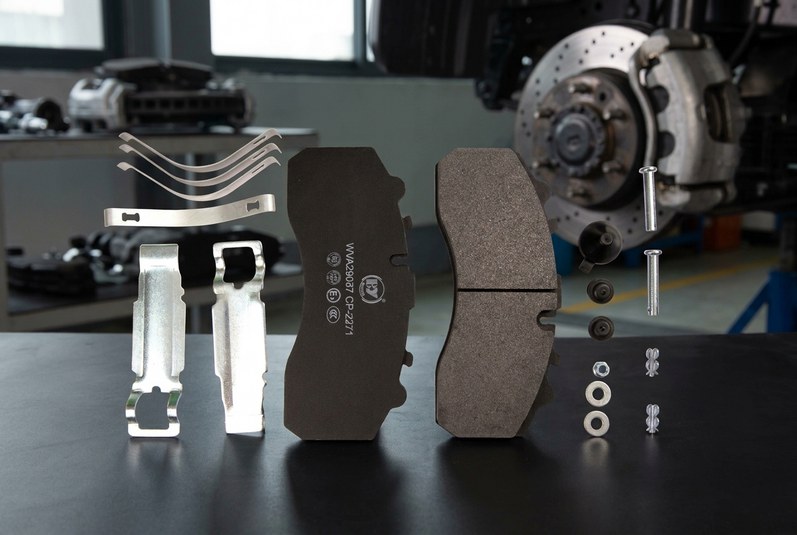
Verification starts with three inputs: your vehicle's VIN or chassis number, the old pad's WVA number or backing plate dimensions, and the supplier's current cross-reference table. From there, check four data points before issuing a purchase order: WVA number, OEM cross-reference, friction class, and dimensional drawing.
| Reference Type | What It Tells You | Why It Matters for Commercial Fleets |
|---|---|---|
| WVA number | Friction material shape and platform identity | Confirms physical fitment across multiple truck and trailer axles |
| OEM/OE reference number | Original equipment part number mapping | Allows direct matching against the vehicle maker's service bulletin |
| Dimensional drawing | Pad length, width, thickness, backing plate features | Detects differences in wear sensor position or attachment clips |
| Friction class / compound code | Temperature range and friction coefficient band | Prevents fitting a highway pad to a mining or refuse vehicle |
No responsible supplier will claim 100% coverage from a single OE number. They'll ask for the VIN or axle model. If they don't, that's a red flag. For brake linings, you may also need to confirm the lining arc, rivet pattern, and drum diameter. Use our request a quote for commercial vehicle brake linings page to include these details in the inquiry.
Key point: Successful part-number verification depends on matching WVA, OEM reference, dimensions, and friction class against the actual vehicle application.
What Role Do WVA Numbers and Dimensional Drawings Play in Fleet Brake Sourcing?
WVA numbers act as the industry shorthand for the friction material's physical interface—the backing plate profile, pad shape, and attachment points. A WVA number does not define the friction material formula or its thermal rating. That's why two pads with the same WVA number can behave very differently in a loaded 40-tonne truck if the compound is wrong.
Dimensional drawings add the second layer of verification. They show pad thickness, slot positions, chamfer angles, and the location of mechanical or electronic wear sensors. A 2 mm difference in backing plate thickness can create caliper fitment issues on some European truck axles. For commercial vehicle operators running mixed fleets, keeping a record of WVA numbers and dimensional drawings reduces wrong-part returns by up to 60% during scheduled brake service. That estimate comes from aftermarket distribution data, where mis-specified parts are the leading cause of workshop returns.
Key point: WVA numbers confirm the pad platform; dimensional drawings confirm axle-level fitment details that a WVA alone cannot capture.
What Are the Most Common Misconceptions About OEM Compatible Chinese Brake Pads?
Misconception: OEM compatible means the pad is identical to the OE part in every way.
Reality: OEM compatible pads must match the OE part's performance within ±15% under ECE R90 testing, but the exact friction formula and production process can differ. That's why aftermarket pads from a Chinese brake manufacturer may use a slightly different compound while remaining fully road-legal and safe.
Misconception: A lower price always means lower brake pad quality.
Reality: The cost difference often comes from lower labor and energy costs in Chinese production, not from inferior materials. The key is certification: a factory holding IATF 16949 and ECE R90 must maintain material traceability and process control. Ask for the test report before judging price.
Misconception: One OE number equals one aftermarket part number forever.
Reality: Vehicle manufacturers supersede part numbers, merge applications, and add variants for different brake caliper suppliers. A single aftermarket part number may absorb several OE numbers, or a new OE number may require a new pad. Always Confirm with supplier catalogue at the time of order.
Key point: Certified OEM compatible Chinese brake pads balance performance, traceability, and cost—but verification against the current catalogue is non-negotiable.
How Can an Importer Reduce Sourcing Risk When Comparing Part Numbers?
A buying decision based only on the lowest unit price creates hidden risk when wrong-fit parts reach a fleet workshop. IATF 16949 requires suppliers to monitor critical characteristics with a process capability index of Cpk ≥ 1.33, but that discipline only helps when the selected part number actually matches the vehicle. Use this checklist before you commit to a container.
- Send the vehicle VIN or chassis number, plus current pad WVA number, to the supplier.
- Ask for the OEM reference cross-reference table in Excel or PDF format.
- Request a dimensional drawing with tolerance fields for length, width, thickness, and backing plate flatness.
- Confirm the friction class and intended application—highway, distribution, construction, mining, or bus rapid transit.
- Request the ECE R90 approval summary or dynamometer test report for the specific part number.
- Check batch traceability: the pad must show a date code, compound code, and production lot number.
BAIYUN Brake has supplied commercial vehicle friction materials for 49+ years, and our IATF 16949 certified facility follows the same verification checklist internally before any export shipment. We expect buyers to hold us to it.
Key point: Structured part-number verification reduces wrong-part returns, protects fleet uptime, and confirms that the lower Chinese aftermarket price still delivers certified performance.
What Questions Do Commercial Vehicle Buyers Ask Before Sourcing OEM Compatible Chinese Brake Pads?
How do I know if a Chinese brake pad will fit my specific truck model?
Q: How do I know if a Chinese brake pad will fit my specific truck model?
A: You need to match the pad's WVA number and dimensional drawing against your vehicle's axle or chassis number. ECE R90 certified pads are application-specific, so one pad platform may fit several truck models but not all. Send your VIN and old pad reference to the supplier to confirm.
What tests prove a Chinese brake pad is truly OEM compatible?
Q: What tests prove a Chinese brake pad is truly OEM compatible?
A: Look for ECE R90 approval, which requires replacement pads to remain within ±15% of OE braking performance after speed and temperature cycles. For production stability, ask for the IATF 16949 certificate and a recent dynamometer test report showing the friction coefficient across the 100–400°C operating range.
Can I order pads by OE number alone without sending a sample?
Q: Can I order pads by OE number alone without sending a sample?
A: Yes, in most cases—if the OE number appears in the supplier's current cross-reference table. However, because vehicle manufacturers supersede OE numbers, the supplier may need the VIN or old pad dimensions to avoid a mismatch. Confirm with supplier catalogue before finalizing the order.
What is the minimum order quantity for OEM compatible commercial vehicle brake pads?
Q: What is the minimum order quantity for OEM compatible commercial vehicle brake pads?
A: MOQs vary by part number and production line setup, but many Chinese brake manufacturers set commercial vehicle pad MOQs between 50 and 200 sets per part number. BAIYUN Brake's export team can confirm the current MOQ after reviewing your target part numbers and annual volumes.
How do I avoid receiving counterfeit or mislabeled brake pads from China?
Q: How do I avoid receiving counterfeit or mislabeled brake pads from China?
A: Work directly with a factory that holds IATF 16949 and supplies pad test reports with each shipment. Check the pad's batch code, compound code, and date code on the packaging and backing plate. A BAIYUN Brake part number will appear in our catalogue with full traceability data, not just a generic label.
What Should You Do Next to Confirm Part-Number Compatibility for Your Fleet?
Before you commit to a container, send us the VIN or chassis number and the current pad's WVA or OEM reference. Our export team will verify the correct BAIYUN Brake part number against the latest catalogue data and issue a formal quote. For commercial vehicle operators, that step typically saves one full procurement cycle and eliminates the risk of mismatch on mixed fleets.
You can browse our heavy-duty brake pad range online, or simply request a wholesale quote with your part numbers attached. We'll map the compatibility for you before you buy.
Was this article helpful?
Average Rating: 5/5 (153)