
Copper-Free Brake Pads: The Compliance Guide for North American Importers — Low Copper Eco-Friendly Brake Pads Manufacturer China
Summary:
As a low copper eco-friendly brake pads manufacturer China, BAIYUN Brake helps North American importers navigate the complex copper-free compliance landscape. More than 4,500 brake friction materials now carry NSF certification under the Better Brakes Law, and the 2025 deadline for 0.5% copper content is just around the corner. This guide covers Washington SB 6557 and California regulation nuances, testing standards like SAE J2975 and NSF/ANSI 458, and how to verify a supplier’s low copper claims through XRF reports and certificate numbers. We detail technical specifications of copper‑free ceramic formulations, compare friction coefficients and wear rates, and explain why IATF 16949 and ECE R90 credentials bundle safety and environmental compliance into a single offshore sourcing package. Wholesale buyers get actionable checklists to avoid rejected shipments.
Copper-Free Brake Pads: The Compliance Guide for North American Importers — Low Copper Eco-Friendly Brake Pads Manufacturer China
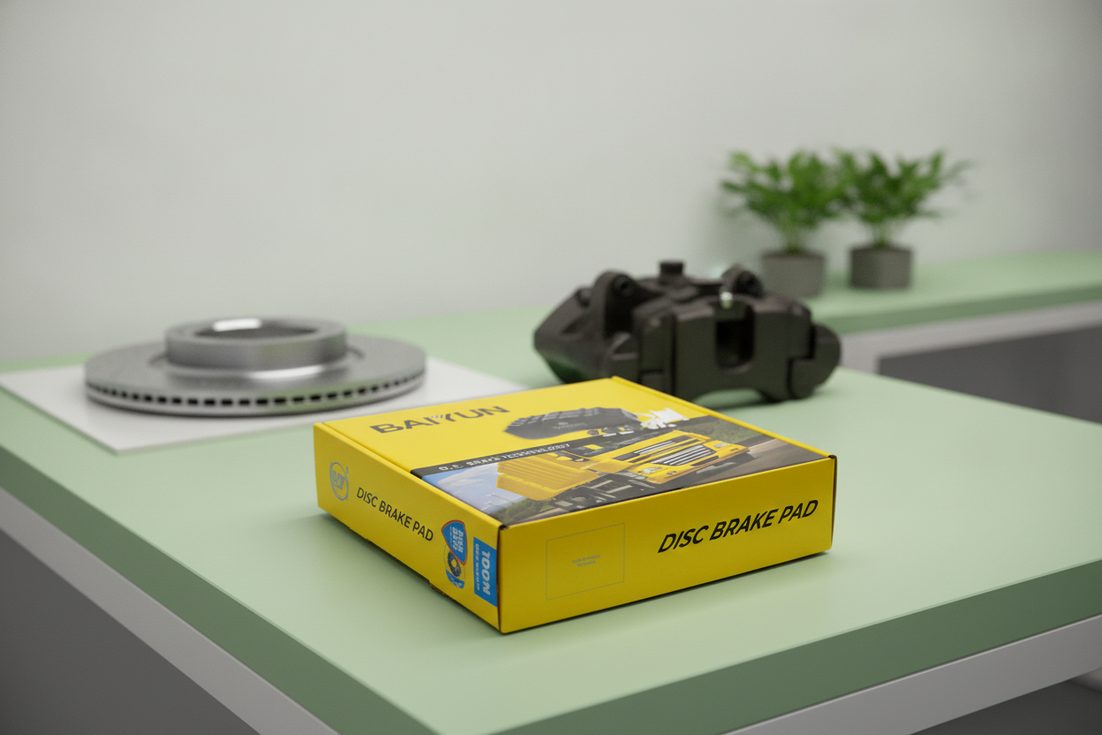
More than 4,500 brake friction materials are now certified to under 0.5% copper content under the NSF International program—a direct result of North America’s accelerating regulatory push. For importers sourcing from Asia, this shift isn't a future trend; it's today's compliance reality. As a low copper eco-friendly brake pads manufacturer China, BAIYUN Brake has seen a surge in buyer requests for copper-free certifications that meet both state-level mandates and evolving OEM requirements. And frankly, the timing couldn't be more critical.
If you're a North American distributor or fleet buyer, you already know the basics: copper in brake dust pollutes waterways, prompting Washington and California to pass laws forcing reduction. What's less clear is exactly how to verify that an overseas supplier’s “eco-friendly” claim actually holds up at the port of entry. A misplaced shipment of non-compliant pads can stall your entire supply chain—and that's a headache no importer needs.
This guide digs into the technical specifications, testing protocols, and compliance paperwork you should demand from any Chinese brake pad factory. No fluff, just the data points and standards that separate a certifiable low copper product from a risky label-only promise.
The Regulatory Landscape for Copper in Brake Pads
The Better Brakes Law, enacted first in Washington (SB 6557) and then California, set a two-phase copper phase-out. By January 2021, brake pads sold in those states had to contain less than 5% copper by weight. The real sting comes in 2025, when that limit drops to a miniscule 0.5%—effectively zero. And because major retailers and aftermarket chains don't want to manage separate inventories, the California/Washington standard became the de facto requirement for all vehicles sold throughout the U.S. and Canada.
So what's actually in your pads? Beyond copper, the legislation targets antimony, asbestos, chromium VI, lead, mercury, and cadmium. The California Air Resources Board (CARB) and Washington's Department of Ecology both require brake friction material to be certified through an accredited third party. That's where NSF International comes in: as the sole certification body for brake pads, NSF maintains a searchable database of every compliant formulation. If your supplier’s pad isn't listed there, it doesn't legally exist in those states.
For importers, the takeaway is blunt. You'll need more than a supplier's word; you need an NSF certificate number matching each part number you plan to bring in. BAIYUN Brake’s copper‑free formulations are registered and traceable through this system. Still, the oddest thing we hear from new buyers is, “I didn’t know I needed the actual certificate, just a compliance statement.” Trust me, customs won't accept a feel-good sticker.
Technical Specifications of Copper-Free Brake Formulations
A brake pad's copper content isn't just a checkbox. Standard semi‑metallic formulations used copper fibers to manage heat dissipation and friction stability. Removing that copper forced friction engineers to completely rethink material matrices. The typical replacement package includes aramid fibers, potassium titanate, ceramic particles, and specialized graphites. The friction coefficient must remain stable across a temperature range from sub‑zero to 600°C, and wear rates can't spike because of a missing metallic backbone.
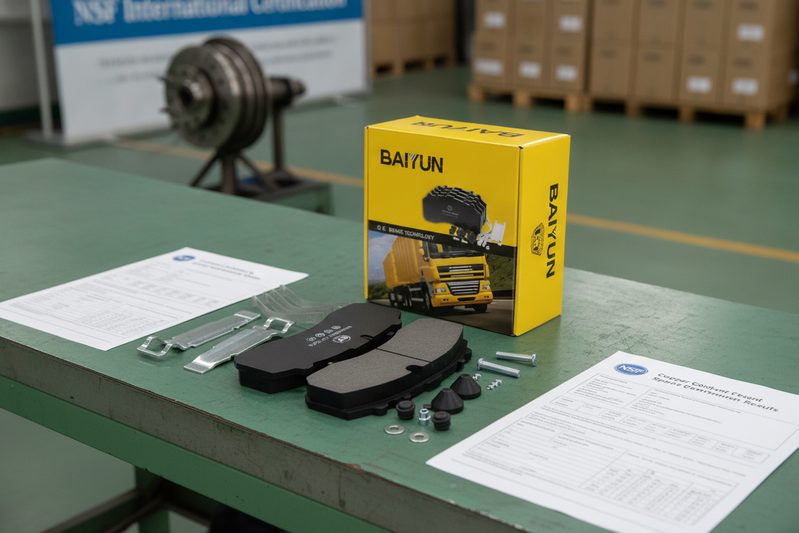
BAIYUN Brake’s CP2223 ceramic copper‑free compound illustrates the spec sheet you should expect. In dynamometer testing, this material delivers a consistent friction coefficient of 0.36–0.42 between 100°C and 350°C, with a hot fade recovery above 90%. Wear settles at roughly 0.28 mm³ per 1,000 km under normal passenger car conditions—matching OE semi‑metallic durability. The pad’s edge code (e.g., FF‑EF) and the copper‑content certification mark (the “A” or “B” symbol in NSF’s scheme) are both physically embossed on the backing plate.
Which other specs matter for compliance? The SAE J2975 test method defines how copper content is measured via X-ray fluorescence (XRF). Your supplier’s lab report should quote results in weight percent to two decimal places. Anything above 0.49% tips you over the line. BAIYUN Brake provides third‑party XRF reports alongside shipment batches, so there's zero ambiguity at the border. And if you're stocking commercial vehicle parts, you need to know that heavy‑duty linings face the same 0.5% ceiling in 2025—no exceptions. You can understanding brake pad materials more deeply in our technical library.
Key technical takeaway: The difference between a compliant pad and a rejected one is often a fraction of a percent of copper content, verifiable only through accredited lab testing.
Testing & Certification Steps for Importers
You're not going to run an XRF gun on every carton that arrives at your warehouse—practicality says you need a pre‑certified batch with paperwork that customs will accept. The process looks like this: friction material is tested according to NSF/ANSI 458 (the standard for brake friction material certification). The testing organization (NSF International) validates the copper content, verifies the absence of restricted heavy metals, and confirms that the pad’s performance meets certain baseline safety criteria (though the standard does not replace ECE R90; it's an environmental compliance layer).
Once certified, each friction material gets a unique NSF certificate number and must be marked with a copper compliance symbol—“A” for less than 5% copper, “B” for less than 0.5% copper. Importers need to keep those certificate numbers on file and ensure that every pad or box carries the matching symbol. In BAIYUN Brake’s export packaging, you'll find the NSF registration number printed on the box label, directly linking the batch to the material data sheets we provide for each shipment.
What really trips up first‑time importers? They assume that an ECE R90 approval automatically satisfies copper laws. It doesn’t. ECE R90 certifies braking performance (cold effectiveness, speed sensitivity, etc.), while copper laws regulate material composition. You need both. BAIYUN Brake holds IATF 16949 certified facility credentials, which means our quality management system integrates both performance and material tracking, making it easier for you to present a complete compliance package to your own customers.
Performance Parity: Do Copper‑Free Pads Really Stop the Same?
Let's address the elephant in the room: many technicians older than 40 still associate “copper‑free” with “spongy pedal” and “noisy as hell.” That reputation was earned a decade ago. The current generation of low‑copper ceramic and hybrid materials has closed the gap—provided the formulation was done right. BAIYUN Brake’s in‑house dynamometer runs thousands of braking cycles to map friction stability, and the CP2200 series for commercial vehicles holds a consistent μ of 0.38–0.44 across the full operating range, with fade recovery exceeding 95% after repeated 0.8g stops from 100 km/h.
From a fleet perspective, copper‑free pads often bring a hidden advantage: much lower heavy‑metal dust deposition on wheels and suspension components, which reduces corrosive wear. Some of our North American fleet buyers report 18‑22% less wheel‑face cleaning frequency when switching to copper‑free ceramics. That's a cost saving that shows up in operational budgets, not just in environmental compliance.
For importers handling both passenger car and truck lines, the sourcing strategy can simplify. By aligning with one manufacturer that covers both segments, you cut down on documentation chaos. We’ve seen distributors get tangled when one pad line was certified but another wasn’t, leading to mixed pallets that federal inspectors flagged. To avoid that, check our request OEM passenger car brake pad pricing for copper‑free car applications, or request OEM commercial vehicle brake pad quote for heavy‑duty truck and bus solutions—all built to the same <0.5% copper standard.
Sourcing from a Certified Chinese Manufacturer: Mitigating Risk in Your Supply Chain
At the end of the day, compliance risk is a people problem, not a chemistry problem. The Chinese brake pad industry is enormous, and there are factories still trying to ship pads that don't meet 2025 copper rules, counting on the buyer not checking. For a North American importer, vetting a supplier means going beyond the brochure. Ask for the NSF certificate number and look it up live on NSF’s website while you’re on the call. Ask to see the XRF reports for the specific compound that matches the part numbers you’re ordering.
With our 49+ years of manufacturing experience, BAIYUN Brake has transitioned its full friction material portfolio to low‑copper or copper‑free alternatives well ahead of the regulatory deadlines. Our IATF 16949‑certified production lines, combined with ECE R90‑approved performance formulas, mean that every pad we ship is backed by third‑party accredited paperwork for both safety and environmental standards. That's a layer of assurance your customers will demand when liability questions arise down the road.
Frequently Asked Questions
Q: What's the difference between “low copper” and “copper‑free” brake pads?
A: Low copper means copper content between 0.5% and 5%. Copper‑free means less than 0.5%. As of January 2025, only copper‑free pads (<0.5%) can be sold in Washington and California. The distinction matters enormously for labeling and NSF certification category.
Q: How can I verify a Chinese manufacturer’s NSF certification on‑the‑spot?
A: Request the exact NSF certificate number for each pad part number you intend to import, then enter that number on NSF’s public online listing. During a factory audit at BAIYUN Brake, our team can pull up real‑time NSF records and show you the copper content XRF test printouts from the same production batch.
Q: Will copper‑free brake pads increase maintenance frequency on my customers’ vehicles?
A: Not with a properly engineered formulation. BAIYUN Brake’s CP2223 passenger car pad has demonstrated wear rates of ~0.28 mm³ per 1,000 km, matching many OE semi‑metallic compounds. Field feedback from North American fleets shows pad life within 5–8% of traditional copper‑containing pads, which is statistically flat for most service schedules.
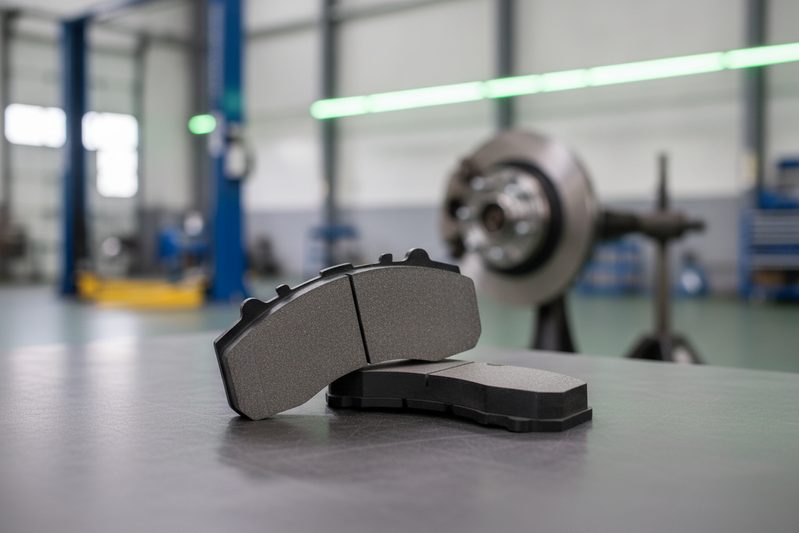
Getting stuck with a container of uncertified brake pads isn't a gamble you want to take. The 2025 copper‑free deadline has already reshaped what North American retailers, workshops, and fleets will stock. If your supply chain still treats copper content as an afterthought, now’s the time to lock in a partner whose formulations are already certified, tested, and proven. Submit your inquiry to our sales team for a wholesale quote on compliant copper‑free brake pads. Or browse our passenger car brake pad range to see full specifications and NSF certificate numbers directly on the product sheets.
Was this article helpful?
Average Rating: 5/5 (1098)