
Ceramic Brake Pads: The Importer’s Complete Buying Guide
Summary:
For importers seeking a reliable ceramic brake pads manufacturer China, this guide details the critical technical specifications, compliance certifications like ECE R90, and performance test data needed to source high-quality, low-noise, and long-lasting ceramic brake pads. Learn how to evaluate material composition, verify safety standards, and build a profitable sourcing strategy for the growing global market.
Ceramic Brake Pads: The Importer's Complete Buying Guide
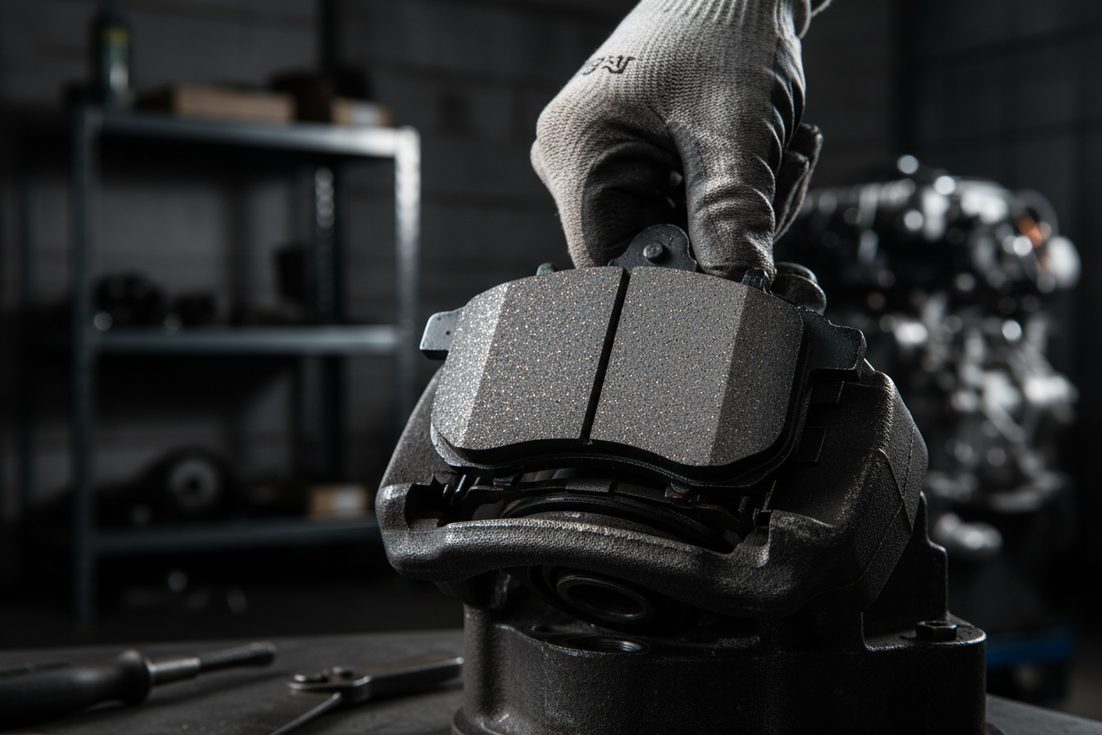
You're sourcing brake pads for a market that demands more than just stopping power. Today's drivers want quiet, clean, and consistent performance. That's why the global ceramic brake pad segment is projected to grow at a CAGR of over 5.5% through 2030, driven by rising consumer awareness and stricter vehicle noise regulations. But for an importer, navigating the technical specifications and compliance landscape from a ceramic brake pads manufacturer China can be complex. This guide cuts through the noise, focusing on the hard data, test standards, and quality benchmarks you need to make an informed purchase decision.
Decoding the Technical Specs: What Your Data Sheets Should Reveal
A product data sheet is your first line of defense against substandard parts. Don't just glance at it; scrutinize it. For ceramic formulations, the friction coefficient (µ) is paramount. You'll typically see two values: a cold µ (measured at 100°C) and a hot µ (measured at 350°C). A quality ceramic pad maintains stability between these points, with a variance of less than ±0.10. A pad that loses too much bite when hot is a safety liability.
Look for specific wear rates, usually expressed in mm/1000 km or cm³/MJ. A superior ceramic compound from a reputable trusted brake pad supplier like BAIYUN Brake might show a wear rate 30-40% lower than a basic organic pad. That translates directly to longer service intervals and happier end-users. Also, check for the compressibility value. Lower compressibility (often below 3%) means a firmer pedal feel and more predictable modulation, which professional drivers appreciate.
So what does that mean for your bottom line? A distributor sourcing 500 sets monthly can't afford inconsistent friction coefficients batch to batch. That inconsistency leads to warranty claims and erodes brand trust. Always request material data sheets that are traceable to specific production lots.
Certifications & Compliance: Your Non-Negotiable Safety Net
Certifications aren't just stickers on a box; they're your contractual and legal safety net. In the European market, ECE R90 certification is mandatory. This isn't a one-time factory audit; it's a type-approval for the specific brake pad/vehicle combination. It verifies performance against 14 separate tests, including fade recovery, wear, and shear strength. Importing non-R90 pads for vehicles requiring them isn't just risky—it's illegal.
For global sourcing, IATF 16949 is the gold standard for automotive quality management systems. It's far more rigorous than ISO 9001. A manufacturer certified to IATF 16949, like BAIYUN Brake, has proven processes for defect prevention, continuous improvement, and supply chain management. It's your assurance that quality is engineered into the product from raw material to finished box. You can learn more about our commitment to these standards on our quality assurance page.
Other marks to look for include the US's FMVSS 135, Japan's JIS, and emerging standards in the Gulf (GCC) and Australian (ADR) markets. Frankly, the price gap between certified and uncertified pads rarely justifies the warranty and liability risk.
Performance Testing: Beyond the Marketing Claims
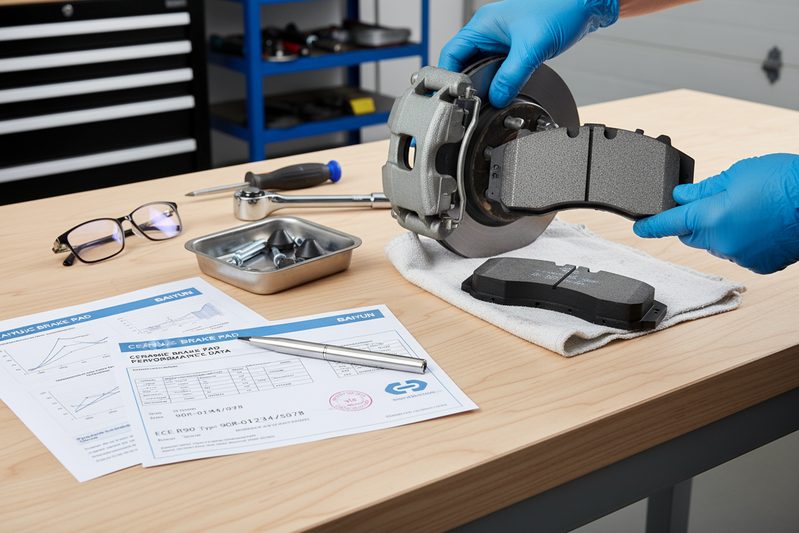
Every manufacturer claims "low noise" and "dust-free braking." The proof is in the test data. Ask for specific results from industry-standard dynamometer tests. The AK Master noise test, for instance, categorizes pads from "quiet" (A-rated) to "noisy" (E-rated). A true low-noise ceramic formulation should consistently achieve A or B ratings.
For dust, request quantitative measurements of particulate generation under controlled test cycles. High-quality ceramics can reduce visible dust by over 80% compared to semi-metallic pads. But there's a trade-off: some ultra-low-dust formulations may have slightly lower initial bite at very low temperatures. A transparent manufacturer will discuss this balance with you.
Perhaps the most critical test is fade resistance. This simulates repeated hard stops, like descending a mountain pass. A pad's friction should not drop below a specified minimum (often 0.25 µ) during the test. Good ceramics excel here due to their stable thermal properties. Reviewing a passenger car brake pad test report gives you concrete numbers to compare suppliers.
Material Composition & The "Ceramic" Label
Here's an industry truth: not all "ceramic" pads are created equal. The term refers to the use of ceramic fibers and non-ferrous fillers, but the exact recipe is proprietary. A premium blend uses high-purity, chopped ceramic fibers for heat dissipation and copper or other non-abrasive metallic particles for conductivity and wear.
Be wary of pads marketed as ceramic that are simply organic pads with a small ceramic additive. They might be cheaper, but they won't deliver the rotor-friendly, long-lasting performance you're promising. The composition directly affects the pad's aggressiveness towards the rotor. A true ceramic formulation is designed to be brake rotor friendly, causing minimal wear and scoring, which extends the life of the entire brake system. For a deeper look at material science, our guide on understanding brake pad materials is a useful resource.
The backing plate matters too. It should be properly cleaned, coated to prevent corrosion (EPD or E-coating), and stamped with clear, permanent markings for traceability. This attention to detail separates professional-grade products from commodity ones.
Sourcing Strategy: Balancing Cost, Quality, and Logistics
Your choice of manufacturer impacts more than just unit cost. Consider the total cost of ownership. A slightly more expensive pad from a manufacturer with advanced R&D might last 20% longer, reducing your customers' brake maintenance cost analysis and boosting their loyalty to your brand.
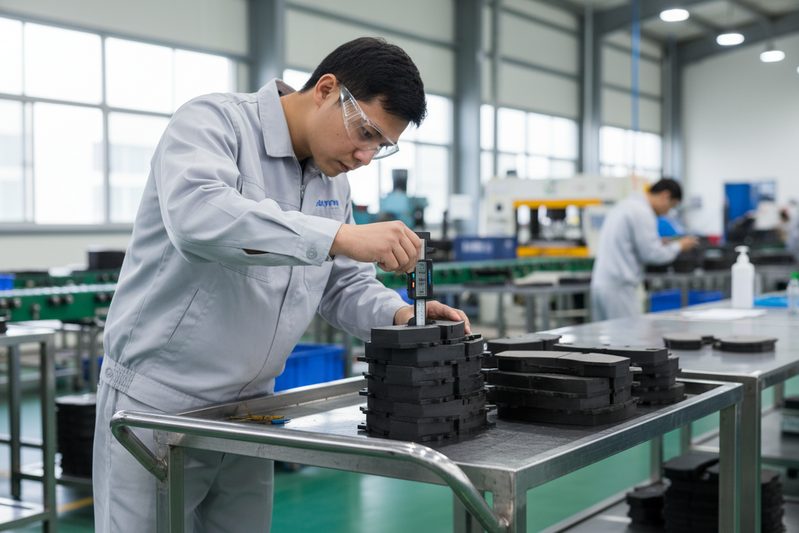
Evaluate their production capacity and flexibility. Can they handle a sudden 10-container order? Do they offer private labeling and custom packaging? What's their lead time from order to shipment? A partner with 49+ years of manufacturing experience typically has the supply chain depth to ensure stability.
Don't overlook technical support. Can they provide installation guides, trouble-shooting manuals, or even training for your installers? A manufacturer that invests in technical support center is investing in your success, not just a transaction.
FAQ for Importers & Distributors
Q: What's the real price difference between ceramic and semi-metallic pads from China?
A: At the factory level, a premium ceramic formulation typically costs 15-30% more than a standard semi-metallic pad. However, this doesn't account for the ceramic's longer life and reduced rotor wear. When you factor in the total system cost and potential for higher retail margins on a premium product, the business case for ceramics is strong for passenger vehicle applications.
Q: How do I verify a manufacturer's ECE R90 certifications are authentic?
A> First, request the official ECE certificate, which will have a unique number issued by the certifying country's authority (e.g., e-mark). You can cross-reference this number on the authority's website. Second, the approval mark (a circle with an 'E' and a number) must be permanently molded or stamped on the brake pad's backing plate, not just printed on the box.
Q: Are Chinese-manufactured ceramic pads suitable for high-performance or luxury vehicles?
A> Absolutely, provided they are from a top-tier manufacturer. The key is the R&D investment. Leading Chinese factories like BAIYUN Brake operate advanced dynamometers, noise test rigs, and have OE experience. They develop specific formulations for different performance profiles. The critical step is matching the pad's technical specifications (friction curve, compressibility) to the vehicle's requirements and your target market's driving conditions.
Choosing the right ceramic brake pad supplier is a strategic decision. It affects your product quality, brand reputation, and long-term profitability. Look beyond the price per box. Partner with a manufacturer that provides transparent technical data, holds rigorous certifications, and demonstrates a commitment to consistent, safe performance. Ready to evaluate a supplier that meets these criteria? Request a quote and detailed technical documentation from BAIYUN Brake today.
Was this article helpful?
Average Rating: 5/5 (2041)