
Brake Pads: Material Selection, Working Principle, and How High Temperature Impacts Performance
Summary:
Brake pads stop a vehicle by turning motion into heat at the pad–disc interface. As temperature rises, molecular bond strength in materials drops, so inferior pads lose stability, wear faster, and lengthen stopping distance—especially at higher speeds or on mountain descents. OE-grade pads use high-temperature-resistant resins and balanced compounds to maintain strength, resist fade, and extend service life. Choosing quality materials is essential for safety and total cost.
Brake Pads: Materials, Principle of Work, and the Role of High Temperature
Braking is energy management. When you press the pedal, the brake system converts kinetic energy into heat through friction between the pad and disc. That heat concentrates at the friction surface and quickly elevates pad temperature. As with nearly all materials, intermolecular bond strength decreases with temperature: thermal agitation weakens molecular interactions, lowering cohesive strength and changing mechanical behavior. This is why material selection decides whether pads remain stable—or fade—under stress.
Material Selection: Why High-Temperature-Resistant Resins Matter
OE-grade pads are formulated with high-temperature-resistant resins and fibers to maintain structural integrity and friction stability at elevated temperatures. Robust binders, proper fillers, and fiber architecture (e.g., mineral/aramid/ceramic fibers) help the pad:
- keep its mechanical strength as heat rises,
- form a stable transfer film on the rotor,
- deliver predictable, linear friction over a wider temperature band, and
- limit wear on both pad and rotor.
Inferior pads often compromise on binder quality or overall formulation. As speed and braking energy increase, these pads run hotter, their molecular link strength drops faster, and performance deteriorates—felt as longer stopping distances, softer pedal feel, odor/smoke, or noise.
Working Principle at the Interface
- The caliper clamps the pad against the disc, generating friction and heat.
- A microscopic transfer layer builds on the rotor; stable compounds maintain this film, stabilizing μ (friction coefficient).
- If the compound isn’t thermally robust, overheating can cause outgassing, surface softening, or glazing, which reduces effective friction—brake fade.
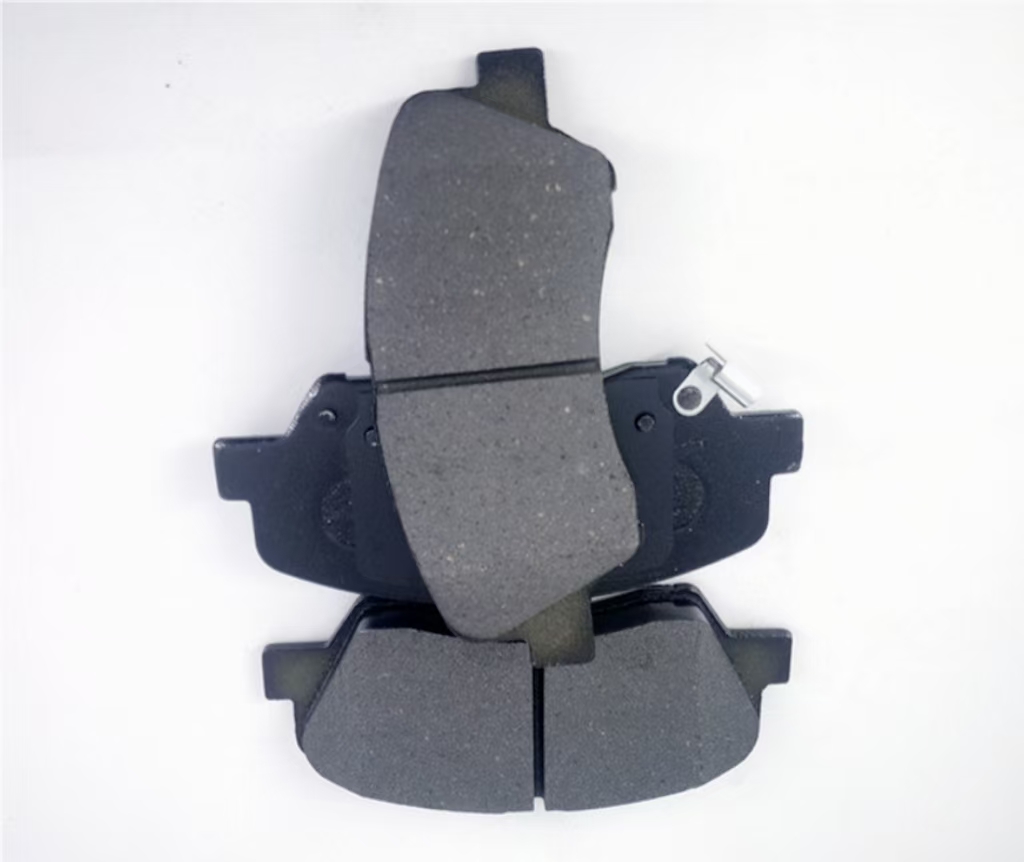
High Temperature: What Changes and Why It Matters
- Lower bond strength: Rising temperature weakens molecular interactions in the binder matrix, risking cohesive failure and accelerated wear.
- Friction instability: Volatile components can gas out; the pad surface may smear, creating micro “air-cushion” effects and a drop in μ.
- Accelerated wear: Hotter operation plus weakened matrix increases abrasive/adhesive wear—service life shortens, especially in mountain driving or frequent emergency stops.
- Rotor stress: Excess heat can contribute to thickness variation and hot spots, causing pulsation and uneven pad wear.
Real-World Implications
City braking at 20–60 km/h may feel stable, but highway speeds or long descents generate far more heat. A pad that seems acceptable in town may not deliver the same stopping consistency at higher energy levels. Hence:
- Choose high-temperature-capable materials, not just “passable” compounds.
- Match pad duty cycle to use case (heavy load, mountain routes, frequent high-speed stops).
- Consider total cost: quality pads often lower lifecycle cost by reducing fade, noise, rotor damage, and replacement frequency.
Selection & Use Checklist
- Prioritize high-temperature-resistant resins and reputable compounds.
- Verify OE/WVA fitment, shims, chamfers, slots, and wear sensor compatibility.
- Look for stable friction across operating temperatures, not just a high peak μ.
- Bed-in properly to establish an even transfer layer.
- Manage heat: use engine braking on descents; avoid long, light brake dragging; don’t shock hot brakes with cold water.
- Maintain the system: clean/lube slide pins, check rotor runout and thickness variation, and replace fluid on schedule.
FAQs
Q1: Why do some pads fade more at high speed?
Because heat load grows with speed. If the binder and compound can’t maintain strength and stable friction at temperature, μ drops and stopping distance increases.
Q2: How do high-temperature-resistant resins help?
They retain mechanical cohesion and support a stable transfer film at elevated temperatures, limiting outgassing, glazing, and rapid wear.
Q3: Does a higher friction coefficient always stop shorter?
Not necessarily. What you need is stable, controllable μ across your real operating temperatures, not a peak value that collapses when hot.
Q4: Why do pads wear fast on mountain roads?
Sustained braking raises temperature; weakened matrix and increased abrasion cause accelerated wear unless the pad is designed for the heat.
Need OE-grade, high-temperature-resistant brake pads for your duty cycle? Contact our engineers for compound matching, fitment lists, MOQ, and lead time.
Was this article helpful?
Average Rating: 5/5 (9645)