
What Documents Should a Brake Pad Supplier Provide?
Summary:
What documents should a brake pad supplier provide? A trustworthy commercial vehicle brake pad supplier must supply ECE R90 and IATF 16949 certifications, material safety data sheets, batch test reports, PPAP documentation for OEM orders, and complete shipping papers. Missing or incorrect documentation causes 38% of rejected shipments from Asia and adds 3-5 days to EU customs clearance. This guide for importers and distributors covers the exact document checklist, buyer verification steps, and common misconceptions about brake pad supplier paperwork.
What Documents Should a Brake Pad Supplier Provide?
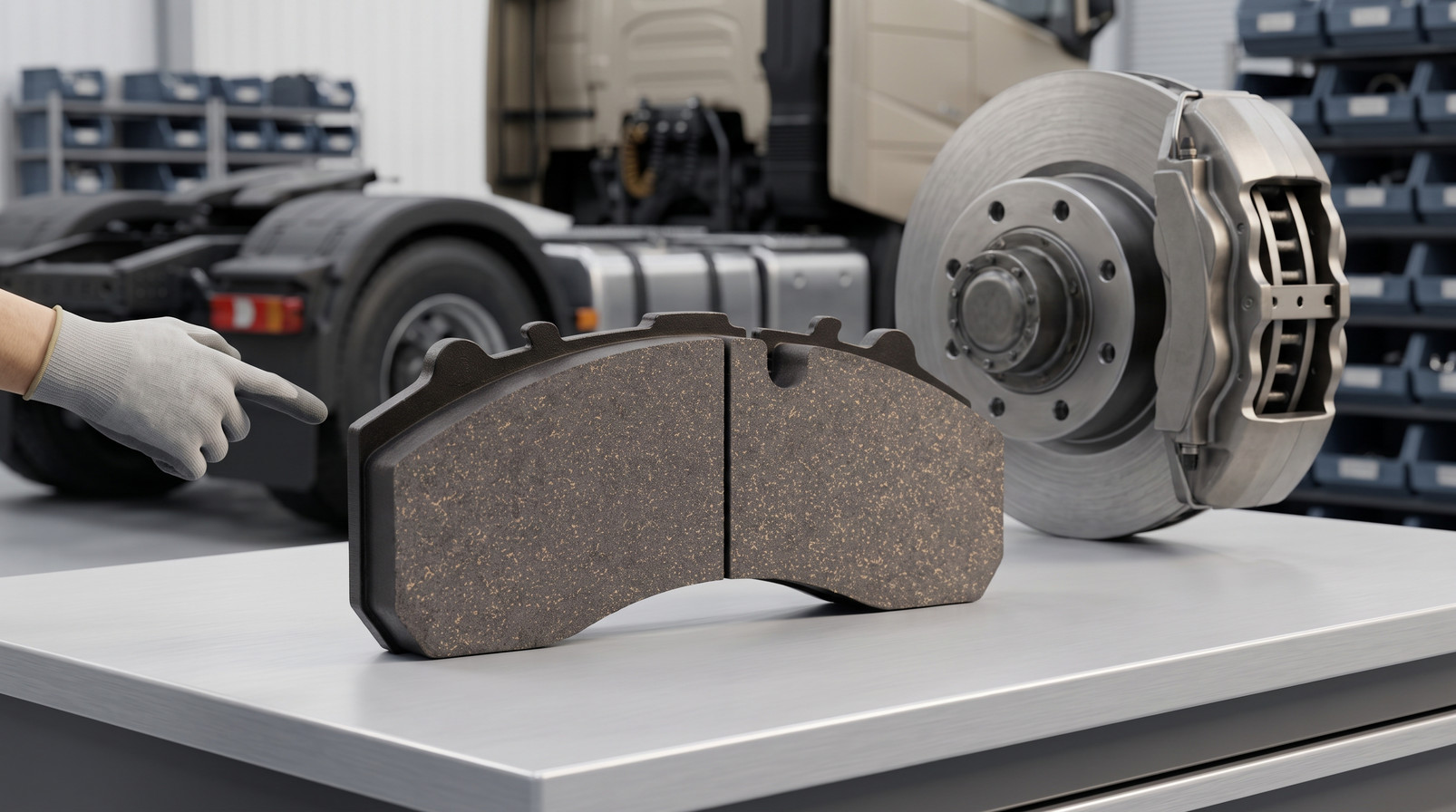
Quick answer: You need documents covering three layers: legal compliance (ECE R90, IATF 16949, ISO 9001), technical performance (friction test reports, material data sheets, PPAP for OEM), and trade logistics (commercial invoice, packing list, certificate of origin, bill of lading). For commercial vehicle brakes, batch traceability and control plan documents matter as much as the pad itself.
Why Do Brake Pad Buyers Overlook Supplier Documentation?
Many importers focus on unit price and lead time, then face customs delays, failed audits, or warranty disputes. A 2025 survey by an international brake parts trading group found 38% of rejected shipments from Asia stem from missing or incorrect documentation, not product quality. That's a costly oversight.
Frankly, documentation is the first signal of a supplier's production discipline. If a factory can't produce a coherent PPAP file, can you trust its friction consistency across 10,000 pads? The two usually go together. Wholesale buyers who skip document review often discover the problem only when a fleet customer returns a batch for uneven wear or noise after 20,000 km.
So before you sign a purchase order, treat the document package as a pre-shipment audit. A supplier that resists sharing batch records or test data isn't protecting trade secrets—they're hiding process gaps.
Bottom line: Documentation is a proxy for production control—suppliers without clean paperwork rarely have clean processes.
What Certifications Prove a Brake Pad Supplier Meets Legal Requirements?
ECE R90 is the non-negotiable regulation for brake pads sold in Europe and many export markets. It requires pads to stay within ±15% of the friction coefficient measured on a reference pad after thermal cycling to 400°C. This isn't paperwork theater—it's dynamometer proof, and the approval number must be marked on the pad or its packaging.
Beyond ECE R90, commercial vehicle buyers should demand IATF 16949 certification. That standard includes 21 automotive-specific quality management elements, from control plans to production part approval. ISO 9001 alone is not enough for automotive-grade safety parts.
An IATF 16949 certified facility must maintain control plans, PFMEAs, and SPC records for every production batch. Ask to see those records—not just the certificate on the wall. Certificates can be suspended or scoped out; the audit reports tell you if the system is actually alive.
BAIYUN Brake holds IATF 16949 and ECE R90 approval for its commercial vehicle brake pad lines. We've also maintained ISO 9001 for over two decades, but we treat ECE R90 as the baseline, not the ceiling.
Certifications are only valuable if the supplier can show the audit reports and test data behind them—ask for the actual certificates and batch-level records.
What Technical Documents Should You Request Before Ordering?
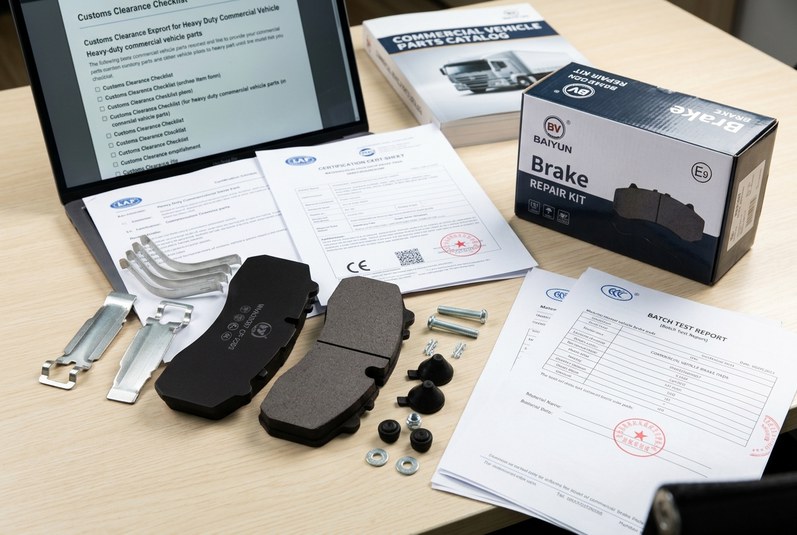
A complete technical package for commercial vehicle brake pads should include a friction material datasheet, a dimensional drawing with tolerances, and a batch test report showing actual dyno results. Without these, you're buying on faith. And brake pads don't reward faith.
For OEM programs, add PPAP Level 3. That's an 18-element dossier covering design records, DFMEA, PFMEA, control plan, measurement system analysis, dimensional results, material test results, and initial process capability studies. PPAP isn't for aftermarket distributors, but if you supply a truck manufacturer or tier-one integrator, you can't skip it.
The table below breaks down which documents fit which buyer profile.
| Document | Purpose | Who Needs It | Typical Format |
|---|---|---|---|
| Material Safety Data Sheet (MSDS) | Regulatory compliance, safe handling | All importers | PDF/SDS |
| Friction test report (SAE J2522 / GB5763) | Verify performance, wear, noise | Fleet and distributors | PDF with dyno charts |
| Dimensional control plan | Confirm fitment across batches | OEM, large fleets | Spreadsheet/CPK data |
| PPAP Level 3 documentation | Prove part consistency for serial production | OEM programs only | 18-element dossier |
| Batch traceability record | Track raw material lots, production date, machine | Auditors, recall management | Barcode/log |
| ECE R90 approval certificate | Legal market access in Europe | EU importers | Certificate + approval number |
You can download material data sheets for reference from our website. These aren't marketing brochures—they include actual friction coefficient curves and wear rates from independent dynamometer testing.
For fleets and distributors buying in volume, request OEM commercial vehicle brake pad quote includes a full documentation pack tailored to your market's customs and regulatory requirements.
Request these documents before sample approval—not after the container ships.
What Quality and Compliance Documents Are Non-Negotiable for Commercial Vehicles?
Commercial vehicle brakes on trucks, buses, and trailers operate at higher temperatures and heavier loads than passenger car brakes, so documentation must reflect real-world duty cycles. A pad that looks fine on a bench test at 100°C can fade badly on a long downhill grade at 500°C.
ECE R90 requires brake pads to retain at least 80% of cold effectiveness after thermal conditioning to 400°C. That's the legal minimum. For commercial vehicles, you should demand batch-level friction reports that cover 350°C to 600°C, plus wear data from repeated dyno cycles.
BAIYUN Brake's CP2201 and CP2203 commercial vehicle pad series undergo dynamometer logging that captures friction at 50°C intervals from 100°C to 600°C. We archive those records for 10 years, so a distributor can pull up the exact batch data if a fleet questions performance after 80,000 km.
ISO 9001 plus IATF 16949 audit frequency matters too. IATF 16949 sites undergo surveillance audits at least annually, and recertification every three years. A supplier whose last audit was three years ago is coasting, not maintaining.
Before you order a 20-foot container of commercial vehicle brake linings, confirm the supplier can provide the complete shipping document set too. Brake pads are a safety part; customs agents in many countries inspect them more closely than generic hardware.
For commercial vehicles, documentation is not a formality—it's the proof that the pad can survive repeated mountain descents without fading.
What Shipping and Trade Documents Does a Supplier Provide?
Importing brake pads involves three sets of trade paperwork: commercial invoice, packing list, and bill of lading. The commercial invoice must declare the correct HS code—8708.30 for brake pads—and country of origin. If that code is wrong, you'll sit in customs for days, sometimes weeks.
Other documents vary by destination. Certificate of Origin (CO or Form A for GSP countries) proves where the goods were made. Packing list shows carton dimensions, weights, and quantities. Bill of lading (B/L) or air waybill is the transport contract. For CIF terms, the supplier also provides insurance certificate.
EU customs holds roughly 12% of unaccompanied brake pad shipments for document verification, adding 3-5 days to clearance. Most holds come from mismatched HS codes, missing ECE R90 approval numbers, or incomplete invoice declarations. That delay costs you money in demurrage and missed delivery windows.
A professional supplier like BAIYUN Brake pre-checks every export document against the purchase order before release. We also provide a digital documentation folder via email before the ship sails, so you can start customs pre-clearance immediately.
Always cross-check the supplier's commercial invoice against your purchase order—discrepancies in part numbers or quantities cause the bulk of customs disputes.
How Does BAIYUN Brake Handle Supplier Documentation?
BAIYUN Brake has supplied brake pads and linings for 49+ years, and that experience shows in how we package our documentation. Every export order from our IATF 16949 and ECE R90 certified facility includes a digital documentation folder: certifications, material data sheets, batch test reports, and shipping documents.
For OEM programs, we provide PPAP Level 3 documentation within 10 working days of production approval. That includes all 18 elements, from design record to initial process capability study. For distributors, we supply a standard export pack that clears customs in Europe, the Middle East, and South America without extra fees.
Our batch traceability system links every pad to a specific raw material lot, production date, press number, and dynamometer test file. That's not because regulators demand it—though they do. It's because a fleet manager calling about pad wear at 60,000 km needs answers, not shrugs.
You can learn more about our 49+ years of manufacturing experience and how we structure quality assurance. If you want to see a sample documentation pack before ordering, just ask. We don't hide our paperwork.
BAIYUN Brake's documentation process is a deliberate part of reducing buyer risk, not an afterthought.
What Are the Most Common Misconceptions About Brake Pad Supplier Documents?
Misconception 1: A valid ECE R90 certificate is enough to guarantee performance. Reality: ECE R90 only sets a minimum threshold; it does not cover noise, wear rate, or high-temperature fade beyond the test procedure. You still need dynamometer reports for those. Many ECE R90-approved pads still squeal or wear unevenly on certain vehicles.
Misconception 2: ISO 9001 is equivalent to IATF 16949. Reality: IATF 16949 includes automotive-specific requirements like control plans, PPAP, and product safety—ISO 9001 is a management system only, without automotive depth. A supplier with only ISO 9001 hasn't proven they can handle serial production for vehicle programs.
Misconception 3: If the factory is certified, you don't need to check documents. Reality: Certificates can be suspended or scoped out. Always verify the certificate validity with the certification body and request current audit reports. A certificate from three years ago doesn't tell you anything about last month's production.
Misconceptions are expensive. Verify, don't assume.
Buyer Verification Checklist for Brake Pad Supplier Documents
Use this checklist before you commit to a brake pad supplier. If any item fails, ask why. If the answer is vague, walk away.
- ☐ Request ECE R90 certificate with approval number and test laboratory name.
- ☐ Verify IATF 16949 certificate validity and scope against the certification body's database.
- ☐ Ask for friction test reports from an accredited lab (SAE J2522 or GB5763).
- ☐ Confirm MSDS matches the specific friction material and includes CAS numbers.
- ☐ Obtain dimensional drawings with tolerances for the exact part numbers you're ordering.
- ☐ For OEM orders, require PPAP Level 3 and confirm the 18 elements are present.
- ☐ For EU shipments, confirm the ECE R90 approval number appears on the pad or packaging.
- ☐ Request batch traceability records for the last three production runs.
- ☐ Check commercial invoice HS code (8708.30) and declared value match your purchase order.
- ☐ Verify packing list carton count and weights against the bill of lading.
Documentation gaps are early warning signs. Don't ignore them.
FAQ: Supplier Documentation Questions from Wholesale Buyers
Q: What documents are mandatory for importing brake pads into the EU?
A: ECE R90 approval certificate, commercial invoice, packing list, and certificate of origin are mandatory. EU customs also expect HS code 8708.30. Missing the ECE R90 approval number is the most common reason for customs holds, adding 3-5 days to clearance.
Q: Should I ask for PPAP documentation for aftermarket brake pads?
A: No, PPAP is normally for OEM production. Aftermarket distributors need material data sheets, friction test reports, and batch traceability records. Request PPAP only if you're supplying a vehicle manufacturer program or a tier-one integrator. PPAP Level 3 includes 18 elements and is overkill for standard aftermarket replenishment.
Q: How can I verify a supplier's ECE R90 certificate is genuine?
A: Ask for the ECE R90 approval number and certificate copy, then check the issuing authority's database. ECE R90 certificates include the test laboratory name and approval date. If the supplier hesitates to share the approval number, treat it as a red flag. Genuine approvals are public record in many jurisdictions.
Q: What is a friction test report and why does it matter?
A: A friction test report shows measured friction coefficient at multiple temperatures, speeds, and pressures. ECE R90 requires friction stability within ±15% of reference after thermal cycling. For commercial vehicles, look for data at 400°C and above. A pad that maintains 0.40 μ at 500°C will behave very differently from one that drops to 0.25 μ.
Q: Does BAIYUN Brake provide documentation for small trial orders?
A: Yes, even a sample order from BAIYUN Brake includes a certificate of conformity, material declaration, and the relevant batch test report. For larger orders, we supply the full export documentation pack to clear customs smoothly. We archive batch records for 10 years, so you can request data long after delivery.
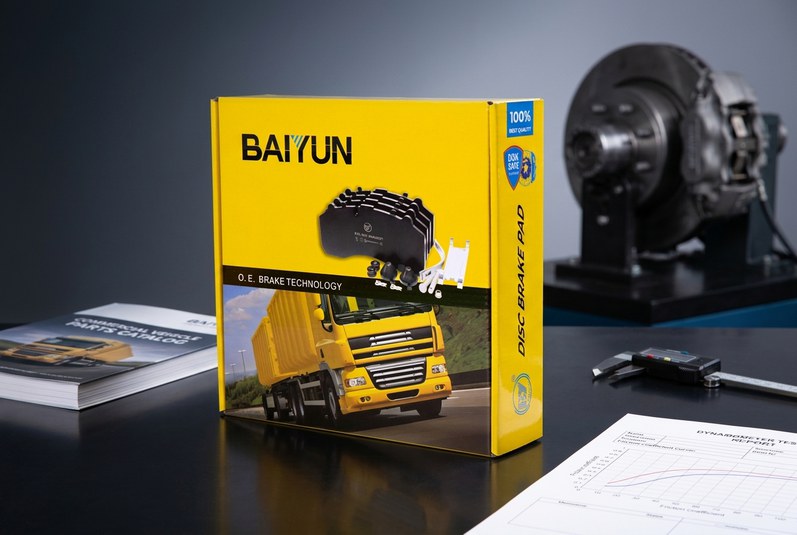
You don't need a perfect document folder from day one, but you do need a supplier who treats paperwork as seriously as they treat friction material. A brake pad that stops a 40-ton truck is only as trustworthy as the data behind it.
If you're sourcing commercial vehicle brake pads or linings and want a documentation pack that survives audit and customs scrutiny, browse our heavy-duty brake pad range or request a wholesale quote from our export team. We'll send sample documents before you commit a single dollar.
Was this article helpful?
Average Rating: 5/5 (328)