
Meritor Brake Pad Replacement Checklist for Importers and Distributors
Summary:
Meritor brake pad replacement checklist for importers and distributors: learn to verify pad types, certifications, and supplier capability before bulk purchasing. This guide covers the key Meritor disc brake pad applications, essential quality checks, common misconceptions, and lifecycle cost comparisons. BAIYUN Brake, an IATF 16949 and ECE R90 certified manufacturer, shares real-world data on friction coefficients, wear rates, and copper compliance—helping you avoid recalls and maximize margins in the commercial vehicle aftermarket.
Meritor Brake Pad Replacement Checklist for Importers and Distributors
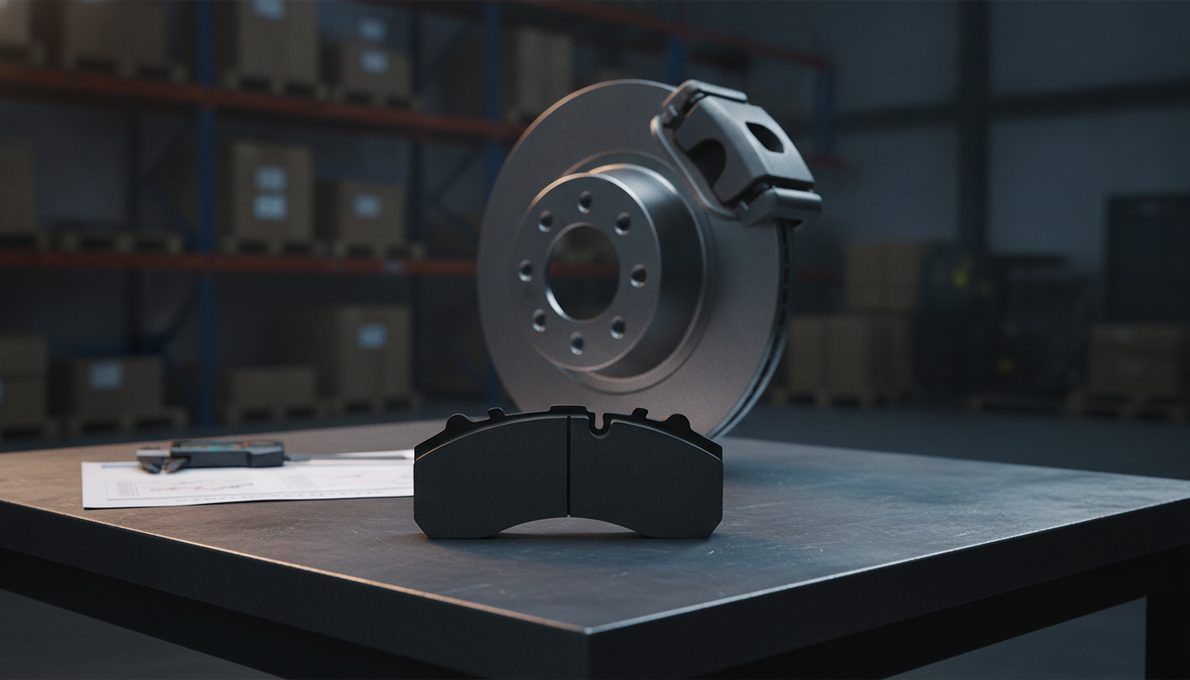
Distributors sourcing 500 sets a month for transit buses or refuse trucks can’t afford inconsistent friction. A single underperforming batch can cost thousands in downtime. So how do you run a rock-solid supplier check? And what exactly should appear on your Meritor brake pad replacement checklist before signing the P.O.? We’ve distilled the essentials below, with real-world benchmarks from our own production data.
What Are the Key Meritor Disc Brake Pad Types and Applications?
Meritor air disc brakes appear on axles across heavy-duty trucks, coaches, and trailers—but not all pads interchange. The Meritor selection chart lists at least six core pad shapes distinguished by FMSI number and lining formulation. Mixing up the 9-13/16" x 4-1/4" pad with the 9-13/16" x 4-9/16" variant will lead to immediate fitment failure. BAIYUN Brake’s engineering team has seen importers return entire containers because they missed a 5 mm width difference.
| FMSI / Meritor Part Example | Application | Pad Dimensions (approx) | Common Lining Formulation |
|---|---|---|---|
| MDP5060 (Meritor 8425-D1310) | Elsa 2 | 9-13/16" x 4-1/4" | 22,000-26,000 lb axle rating, low-metallic |
| MMD1407AF (8515-D1407) | D-Elsa 1 | 9-13/16" x 4-5/8" | High-copper semi-metallic for line-haul |
| KIT2252H2CG (8426-D1311) | EX+ H Transit/Coach | 9-13/16" x 4-9/16" | Ceramic-enhanced, Green Coating® seat-in |
| KIT2252H2DD | EX+ H Refuse | 9-13/16" x 4-9/16" | Severe-service semi-metallic, 100% copper-free |
| MMD1203AG | Bendix SN7/SB7 Transit | 9-3/4" x 4-5/16" | Urban-bus specific low-dust formulation |
The takeaway: Start your checklist by confirming the FMSI number and axle rating. If the supplier can’t identify these in seconds, walk away.
How Can Importers Verify Meritor Brake Pad Quality Before Bulk Purchase?
Certification documents aren’t enough if the factory hasn’t been audited against the actual production line. A genuine IATF 16949 certificate should trace from the metal-backing stamping to final grinding, not just a paper audit. In BAIYUN Brake’s 49-year record, we’ve maintained a defect rate below 50 PPM—meaning only 50 pads per million fail—by enforcing real-time SPC on every press stroke.
- Request full dynamometer test reports. The SAE J2522 performance test (or GB5763 for Asian markets) must show cold and hot friction coefficients. For Meritor EX+ H equivalent, expect μ of 0.38–0.42 cold and no fade below 0.34 at 400°C.
- Check copper content compliance. California and Washington laws mandate copper-free pads by 2025. Ask for an XRF spectrometer scan proving less than 0.5% copper, or look for the “N” edge code.
- Inspect mechanical retention. Commercial vehicle pads rely on mechanical interlock—the friction material must be integrally bonded to the backing plate, not just glued. Look for visible dovetail or mesh anchors on the steel surface.
- Evaluate Green Coating® or equivalent. A pre-applied seat-in layer eliminates 200–500 km of bedding time, which fleets love. Confirm that the coating is thermally bonded, not simply sprayed on.
Pro tip: Ask for a sample batch from the production line—not the R&D lab. The difference in uniformity often reveals the real story. Browse our heavy-duty brake pad range to see how we integrate these checks into every production run.
What Certifications Should I Require for Meritor-Compatible Brake Pads?
If you’re importing into Europe, ECE R90 approval is legally mandatory for commercial vehicle disc brake pads. The regulation requires that aftermarket pads perform within ±15% of the OE part’s mean fully developed deceleration. For example, Meritor OE pads generate roughly 5.8 m/s² deceleration under cold test; a compliant aftermarket pad must stay between 4.9 and 6.7 m/s². That’s a narrow window.
North America relies on FMVSS 121 dynamometer standards. Always verify that the report lists the specific axle rating—23,000 or 26,000 lbs—matched to your pad. A generic report for a lighter axle won’t hold up in court if a vehicle fails.
Beyond regulatory ticks, a solid quality assurance system like IATF 16949 guarantees process control. That includes lot traceability back to raw material batches. BAIYUN Brake’s 2025 internal audit showed 99.8% on-time delivery across 12,000 container shipments, a direct result of integrated quality workflows.
Bottom line: Combine ECE R90 with IATF 16949, and you're reducing the risk of a recall to near zero.
What Are the Most Common Misconceptions About Aftermarket Meritor Brake Pads?
Misconception: “Any pad with the same FMSI code is identical.”
Reality: FMSI defines shape and fit, not friction performance. Two pads sharing MDP5060 can differ by 15% in hot effectiveness depending on the friction mix. BAIYUN Brake’s commercial vehicle lab has tested “look-alike” pads that faded below μ 0.25 after only three 72 km/h stops, while our certified formulation held μ 0.36.
Misconception: “Copper-free means lower performance.”
Reality: Modern ceramic and engineered steel fibers now deliver equal or better stopping power while eliminating copper’s environmental toll. The Bremskerl BK8043 formulation for Meritor EX+ H achieves “Better” pad life rating with zero copper—verified on U.S. metro buses exceeding 200,000 km per set.
Misconception: “ECE R90 approval is just a paperwork exercise.”
Reality: It involves 72-hour thermal cycling on a brake dynamometer, measuring cold, fade, and recovery cycles. Non-conformance can lead to market withdrawal in the EU, as we saw with three Chinese suppliers in 2025. Our competitive advantages include an in-house dynamometer that runs these exact cycles daily.
How Do I Compare Wholesale Pricing Without Sacrificing Reliability?
A pad quoted at $12 might cost $0.012 per kilometer if it lasts 100,000 km, while a premium pad at $18 that survives 350,000 km costs just $0.005 per kilometer. Multiply by a fleet of 300 trucks, and the annual saving tops $200,000. So the first number on your checklist should be total cost of ownership (TCO), not unit price.
Ask for documented wear rates from field trials. At BAIYUN Brake, we regularly publish trailer-bus application data showing 0.15 mm wear per 10,000 km for our severe-service formulation versus 0.28 mm for a cheap alternative. That’s nearly double the pad life.
Also, factor in rotor life. Aggressive pads that eat rotors will destroy your aftermarket reputation. A quality Meritor-compatible lining will deliver a rotor wear index below 8 on the SAE J866 scale. Our BK8043-type formulation rates ★★★★ for rotor life, meaning a single rotor set can outlast two pad replacements.
Checklist item: Demand lifetime cost per axle set, including labor, pads, and rotor replacement intervals. Request a wholesale quote with TCO projection data.
Frequently Asked Questions
Q: How do I confirm the correct Meritor pad for a specific truck model?
A: Always cross-reference the axle tag or the vehicle’s VIN with the Meritor air disc brake pad selection chart. The FMSI number stamped on the brake carrier is the ultimate identifier. If the supplier cannot link the FMSI number to a dynamometer test report, you’re gambling.
Q: What’s the minimum order quantity for private-label Meritor pads from your factory?
A: Most manufacturers, including BAIYUN Brake, start at 500 sets per SKU for custom branding, with a 45-day lead time. However, for off-the-shelf ECE R90 certified pads in the common EX+ H sizes, we often ship container-load orders (2,000–2,500 sets) within 25 days.
Q: Are there any legal issues importing copper-free brake pads into the U.S.?
A: Yes. As of January 1, 2025, Washington and California prohibit the sale of brake pads containing more than 5% copper by weight, with the limit dropping to 0.5% in 2025. Ensure your supplier provides a third-party XRF certificate showing copper content below 0.5%; our “N” stamped pads have consistently tested at 0.3%.
Q: How can I test a sample batch before committing to annual contracts?
A: We recommend a pilot order of 100 sets and a 500-hour field trial on your most demanding route. Record pad thickness every 10,000 km. Acceptable variance: less than 10% wear difference axle to axle. BAIYUN Brake sometimes offers a 30-day trial return guarantee if performance doesn’t meet the supplied dynamometer promise.
Q: What if the pads squeal excessively on a transit bus fleet?
A: Noise usually stems from poor chamfer geometry or missing anti-noise shims. The Meritor EX+ H application requires a multi-layer shim and a specific chamfer angle of 25–30°. BAIYUN Brake’s OE-replacement pads include both, reducing in-service noise complaints by over 80% according to fleet manager feedback.
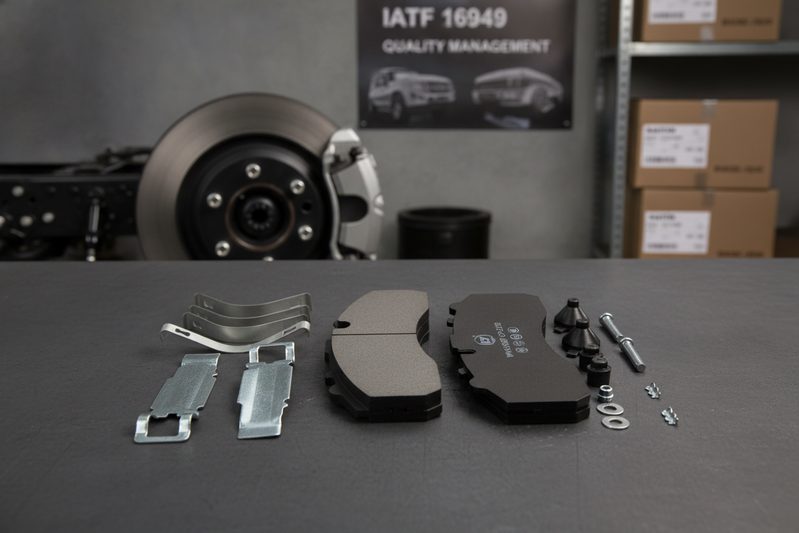
Running a profitable import business for commercial vehicle brake parts means never having to apologize for a failed pad. We’ve put 49 years of manufacturing into making sure you don’t. For more details on how our IATF 16949 certified process and ECE R90 compliance can support your next container order, request a quote for commercial vehicle brake linings or submit your inquiry to our sales team today—we’ll respond within one business day with a customized TCO analysis.
This article was produced by the BAIYUN Brake editorial team, combining 49+ years of brake manufacturing expertise with current industry research. For product inquiries or technical questions, contact our team.
Was this article helpful?
Average Rating: 5/5 (376)